Building a strong software product is only part of creating a successful customer experience.
If users cannot understand how the product works, find answers when they need them, or discover relevant features, they may depend heavily on support or fail to realise the product’s full value.
Well-designed product documentation gives users clear guidance throughout their journey, from getting started and completing everyday tasks to troubleshooting problems and adopting new capabilities.


Product documentation is the structured information that helps users, administrators, support teams, and other audiences understand, configure, use, troubleshoot, and maintain a software product.
It may include product overviews, installation and configuration guidance, tutorials, task-based instructions, troubleshooting resources, release information, and technical references.
Effective product documentation is organised around what different users need to accomplish. It should also evolve alongside the product so that information remains accurate, consistent, and aligned with each release.
Give users a structured path for understanding the product and beginning to use its core capabilities.
Make answers to common questions easier to find without requiring users to contact support each time.
Help users understand relevant features and how those capabilities support their goals.
Provide clear and consistent guidance across onboarding, everyday use, troubleshooting, and product changes.
Give customers and internal teams a shared, maintained source of product information.
Keep guidance aligned with new features, product changes, deprecations, and releases.
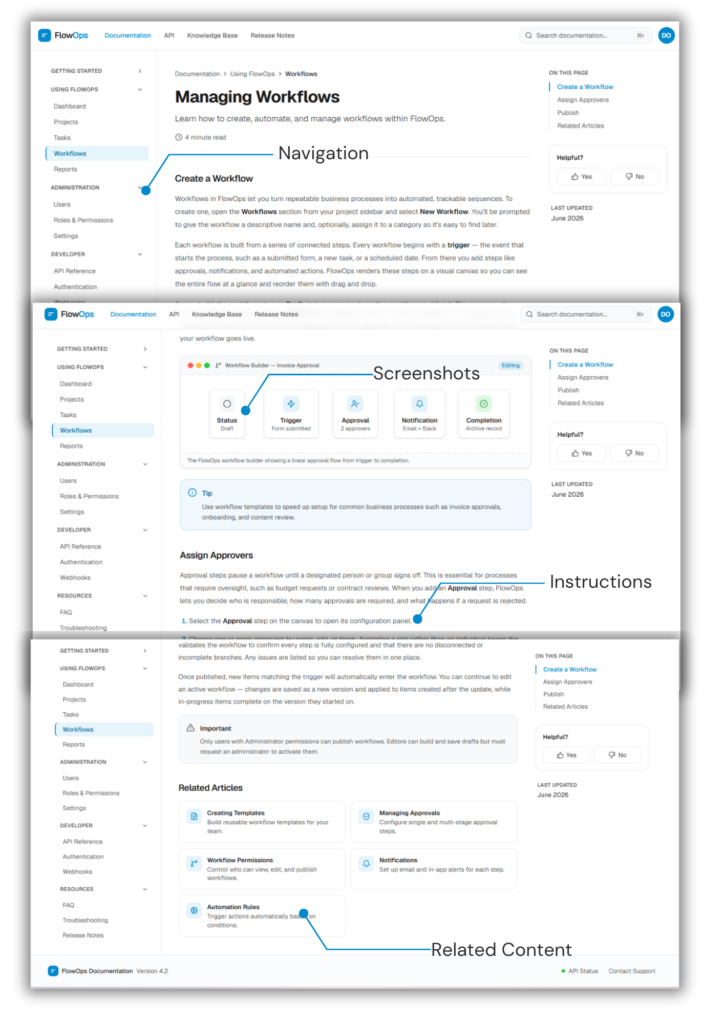
The FlowOps documentation portal illustrates how well-structured product documentation helps users find answers, complete tasks, and become successful with your product.
The FlowOps documentation portal illustrates how well-structured product documentation helps users find answers, complete tasks, and become successful with your product.
Your documentation may need attention if:
Product teams introducing and explaining product capabilities
Customer-success teams supporting onboarding and adoption
Support teams resolving recurring questions consistently
Developers reducing repeated requests for product explanations
Administrators responsible for configuration and maintenance
End users learning how to complete tasks and solve problems
Every product is different, but our approach follows three practical stages.

We analyse your product, audiences, user journeys, existing documentation, support questions, and publishing environment to identify gaps that affect understanding and use.
We organise information around user needs and create clear, task-focused documentation with consistent terminology, intuitive navigation, and practical examples.

We establish documentation standards, ownership, review points, and maintenance processes so the content remains aligned with product changes.
Every engagement is tailored to your product, audiences, existing content, and publishing environment. Depending on your requirements, your documentation may include:
Product Onboarding
User Documentation
Administration
Customer Support
Product Lifecycle
Developer Resources
Every engagement is tailored to your product, audiences, existing content, and publishing environment. Depending on your requirements, your documentation may include:
A user guide is one component of product documentation. It focuses primarily on helping users understand features and complete tasks.
Product documentation is the broader information system supporting different audiences throughout the product lifecycle. It may include getting-started content, configuration guidance, user guides, administrator documentation, troubleshooting resources, release notes, and developer documentation.
Yes.
We can create documentation for products already in production as well as software that is still being developed.
Where documentation is incomplete or does not yet exist, we work with the available product information and subject-matter experts to understand how the product works and validate the resulting content.
Yes.
Depending on the project, we may collaborate with product managers, developers, QA teams, implementation specialists, customer-success teams, and support teams.
Their input helps us understand the product, resolve information gaps, reflect real user questions, and validate the documentation before publication.
We establish clear ownership, review points, and documentation-maintenance processes linked to the product-development and release cycle.
Updates may be triggered by new features, interface changes, revised workflows, known issues, deprecations, or customer feedback. The exact process is designed around your team and release frequency.
The timeline depends on the product’s complexity, existing documentation, number of audiences, required deliverables, and availability of subject-matter experts.
An indicative engagement may follow these stages:
Evaluate: approximately 2–3 weeks
Documentation audit, audience and requirements review, content analysis, and information-architecture planning.
Engineer: approximately 4–8 weeks
Creation of new documentation or restructuring and rewriting of existing content.
Elevate: approximately 2–3 weeks
Validation, documentation standards, ownership, maintenance processes, and handover. A full engagement may therefore take approximately 8–14 weeks. Smaller or more focused initiatives may be completed sooner. During the Strategic Review, we’ll recommend a realistic timeline based on your product, priorities, and internal review capacity.
You’ll receive prioritised recommendations outlining the most valuable improvements for your product documentation.
From there, you can choose the level of support that best suits your priorities, timeline, and budget. We can:
The Strategic Review does not commit you to a larger engagement.
Yes. Ongoing support can help keep documentation aligned with releases, feature updates, customer feedback, and changing business requirements.
Retainer support may include:
Yes.
Product documentation can be structured for different audiences, including end users, administrators, implementation teams, support teams, developers, and integration partners. Each audience should receive the information, terminology, and level of technical detail relevant to its responsibilities.
If your business is becoming harder to manage, it’s time to put the right systems in place.
Take a quick assessment to evaluate your current practices, identify gaps, and receive actionable insights for improving your governance.