Modern software rarely works in isolation.
Whether it’s a CRM connecting to an ERP, a payment gateway processing transactions, or a mobile app retrieving customer data, software systems communicate through Application Programming Interfaces (APIs).
An API defines how different applications exchange information. But even the best-designed API becomes difficult to use if developers cannot quickly understand how it works.
Without clear documentation, integrations take longer, implementation errors increase, and engineering teams spend valuable time answering questions that good documentation should already address.
Clear API documentation helps developers integrate with confidence, reduces support effort, and improves the overall experience of working with your product.

Product documentation is the structured information that helps users, administrators, support teams, and other audiences understand, configure, use, troubleshoot, and maintain a software product.
It may include product overviews, installation and configuration guidance, tutorials, task-based instructions, troubleshooting resources, release information, and technical references.
Effective product documentation is organised around what different users need to accomplish. It should also evolve alongside the product so that information remains accurate, consistent, and aligned with each release.
Introduce the API, its purpose, and the problems it solves so developers understand where to begin.
Help developers connect securely without unnecessary trial and error.
Provide a clear path to making the first successful API request.
Document every endpoint consistently so developers know exactly how each request behaves.
Provide practical examples that developers can adapt quickly during implementation.
Explain error codes, common causes, and recovery steps that reduce support requests.
Document rate limits, pagination, supported formats, payload limits, and other implementation requirements.
Describe available events, payloads, and delivery behaviour where applicable.
Clearly communicate supported versions, deprecated functionality, and breaking changes.
The Business Impact of Better API Documentation
Well-designed API documentation benefits more than developers. It helps your business:
Help customers and partners integrate with your platform more quickly.
Reduce implementation support while providing developers with a trusted technical reference.
Support product launches with documentation that keeps pace with development.
Reduce repeated questions by creating a consistent source of technical knowledge.
Resolve integration issues more quickly with reliable technical documentation.
Build and maintain integrations with greater confidence and less back-and-forth.
Every engagement is tailored to your API, your developers, and the way your documentation will be published.
A typical API documentation project includes:
Documentation can be delivered as a developer portal, documentation website, knowledge base, or integrated documentation platform, depending on your product and technical environment.
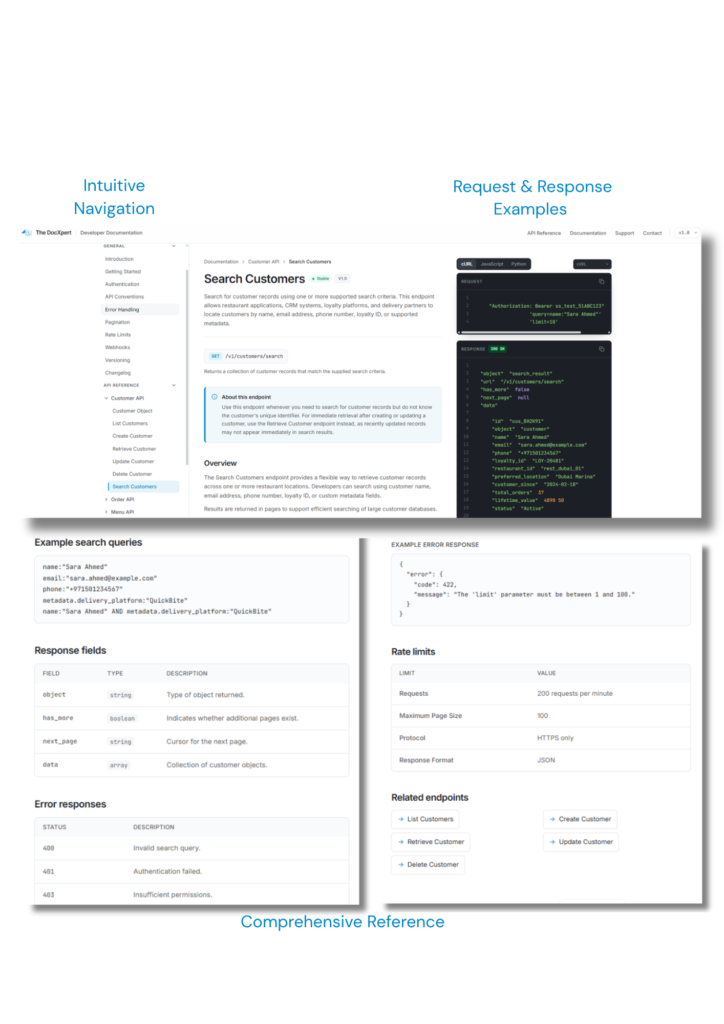
Core Documentation
Developer Guidance
Supporting Information
Every engagement is tailored to your API, your developers, and the way your documentation will be published.
A typical API documentation project includes:
Documentation can be delivered as a developer portal, documentation website, knowledge base, or integrated documentation platform, depending on your product and technical environment.

We begin by understanding your API, existing technical information, intended users, and the challenges developers experience during integration.

We organise technical information into clear, structured documentation using consistent terminology, practical examples, and logical navigation.

We validate the documentation with your technical team, refine it for usability, and prepare it for publication and long-term maintenance.

Highlighted features
Yes.
We can create documentation for existing APIs, even if little or no documentation currently exists.
Yes.
We can review your existing documentation, identify gaps, improve the structure, standardise terminology, and rewrite unclear or outdated content.
Yes.
Our team combines technical writing expertise with software engineering knowledge. This enables us to work effectively with developers and produce documentation that is technically accurate and easy to use.
Absolutely. We collaborate with developers, architects, product managers, and technical leads throughout the documentation process to ensure the documentation accurately reflects how the API works.
Yes.
We can create documentation from source code, Postman collections, developer walkthroughs, technical discussions, or existing implementation material.
Yes.
Creating documentation alongside development often helps identify inconsistencies, missing information, and opportunities to improve the developer experience before release.
Absolutely. API documentation is most valuable when it evolves alongside your product.
We offer ongoing documentation support to help keep your API reference, examples, version history, and release documentation up to date as new features are introduced. Whether you release monthly or several times a week, we can work as an extension of your team to ensure your documentation remains accurate and useful for developers.
If your business is becoming harder to manage, it’s time to put the right systems in place.

Take a quick assessment to evaluate your current practices, identify gaps, and receive actionable insights for improving your governance.