Policies. Procedures. Technical documentation. Product knowledge. Training materials. Customer support articles. Internal expertise.
Every growing organisation accumulates knowledge.
Making that knowledge easy to find, trust, and maintain is what transforms it into a valuable business asset.
As organisations grow, information becomes scattered across shared drives, emails, chat conversations, documents, and individual desktops. Employees spend valuable time searching for answers, support teams answer the same questions repeatedly, and valuable knowledge becomes harder to access.
A well-designed knowledge base creates a single source of truth that connects people with the information they need. Instead of searching through folders or relying on individual employees, people can quickly find trusted answers and continue with their work.


A knowledge base is more than a collection of articles. It’s an information system that connects employees, customers, and partners with trusted organisational knowledge.
Rather than storing information in disconnected folders, emails, or documents, a knowledge base organises knowledge around the way people search for it. Content is categorised, searchable, interconnected, and governed so users can quickly locate reliable information whenever they need it.
Powerful search, intuitive navigation, and a clear information structure help people spend less time searching and more time getting work done.
Whether it’s supporting customers, onboarding employees, documenting technical systems, or sharing operational procedures, a knowledge base ensures knowledge remains accessible as your organisation grows.
Enable employees and customers to find answers independently, reducing reliance on support teams.
Minimise repetitive questions by providing a trusted source of information.
Help teams make faster, more consistent decisions by providing access to accurate, up-to-date information.
Give every team access to the same trusted information, helping work be completed consistently across departments and locations.
Help new employees become productive sooner with structured, searchable resources.
Capture valuable organisational knowledge before it leaves with experienced employees.
Keep information organised, consistent, and easy to update as your business evolves.
Your organisation may benefit from a knowledge base if:

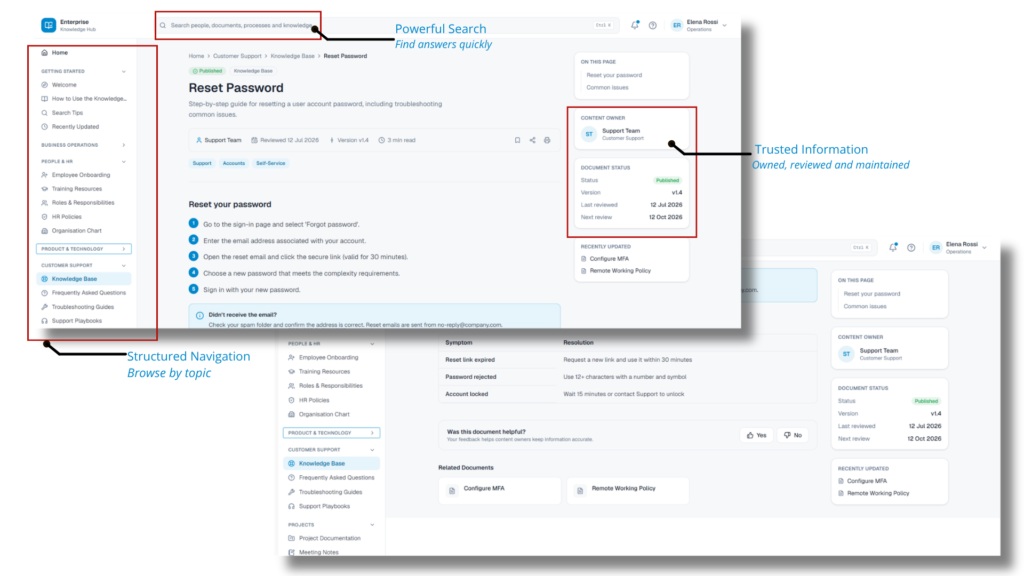
A great knowledge base makes information easy to find, easy to trust, and easy to maintain.
Powerful search, logical navigation, meaningful categories, and connected content help people locate information quickly.
Clear ownership, version control, review schedules, and consistent standards ensure information remains accurate and reliable.
Templates, governance, and a scalable structure keep information organised, current, and easy to update as your organisation grows.
Your organisation may benefit from a knowledge base if:

A knowledge base brings together information from across your organisation into one searchable, trusted resource.
It may include:
A great knowledge base makes information easy to find, easy to trust, and easy to maintain.
Powerful search, logical navigation, meaningful categories, and connected content help people locate information quickly.
Clear ownership, version control, review schedules, and consistent standards ensure information remains accurate and reliable.
Templates, governance, and a scalable structure keep information organised, current, and easy to update as your organisation grows.
Every engagement begins by understanding how knowledge moves through your organisation.

Understand where knowledge exists, how people search for information, where duplication occurs, and which information people struggle to access.

Design an information system that organises knowledge into logical categories, improves navigation, establishes documentation standards, and creates a structure that is easy to search and maintain.

Embed governance, establish ownership and review cycles, and help your knowledge base continue delivering value as your organisation grows.
Documentation consists of individual resources such as user guides, SOPs, policies, and API documentation. A knowledge base organises those resources into a searchable information system that makes knowledge easy to find, maintain, and use.
Shared drives organise files. A knowledge base organises information.
Instead of expecting people to know where a document is stored, a knowledge base makes information searchable, interconnected, and easy to discover regardless of where it originated.
Absolutely.
Most organisations don’t need hundreds of articles before they see value. We often begin with the information your employees and customers use every day, then expand the knowledge base as your organisation grows.
Yes.
We design knowledge bases for employees, customers, partners, support teams, and technical users, depending on your business objectives.
Absolutely.
We can review your current content, remove duplication, improve organisation, standardise documentation, and create a structure that’s easier to maintain.
We design the information architecture first and then organise content within the platform that best suits your business. We can work with platforms such as Confluence, SharePoint, Notion, GitBook, Document360, Zendesk, and many others.
We establish ownership, review schedules, governance, and documentation standards so your knowledge base continues to evolve alongside your organisation.
Every knowledge base is different and the timeline depends on the amount of existing content, the quality of the information, and whether we’re building from scratch or improving an existing system.
Smaller knowledge bases can often be completed in a few weeks, while larger, organisation-wide knowledge management projects may be delivered in phases over several months.
During your Strategic Review, we’ll recommend an approach and timeline based on your business goals, priorities, and available resources.
You’ll receive a prioritised roadmap outlining the most valuable opportunities to improve your knowledge base.
From there, you can choose the level of support that best suits your organisation:
Many organisations begin with a focused project and continue on retainer as their knowledge base evolves. During your review, we’ll recommend an approach that aligns with your priorities, timeline, and business goals.
Yes. Many organisations retain us to review, update, and expand their knowledge base as new products, processes, and information are introduced.
Together, we’ll review how information is currently organised, evaluate how easily people can find and trust the knowledge they need, identify opportunities to strengthen your information system, and provide practical recommendations that support productivity, consistency, and long-term growth.
Every review is confidential, practical, and completely non-binding.
If your business is becoming harder to manage, it’s time to put the right systems in place.

Take a quick assessment to evaluate your current practices, identify gaps, and receive actionable insights for improving your governance.