

Governance Frameworks

Establish governance frameworks that support accountability and better business decisions.

Better Decisions Need Clear Governance

A governance framework provides the structure that guides how decisions are made, responsibilities are assigned, and accountability is maintained.As organisations grow, decision-making often becomes less clear. Similar decisions may be handled differently, approvals become concentrated with a few people, and employees may be unsure who has the authority to act.Effective governance clarifies decision authority, accountability, approval pathways, and escalation routes so the business can make consistent decisions without creating unnecessary bureaucracy.

What Is a Governance Framework?

A governance framework is a structured system that defines how decisions are made, who has the authority to make them, who is accountable for the outcome, and how important matters are monitored or escalated.It brings together decision rights, responsibilities, approval pathways, reporting structures, oversight mechanisms, and operational controls.A practical governance framework helps an organisation make consistent decisions, distribute authority appropriately, and maintain accountability as it grows.

What Effective Governance Defines

Decision Authority

Clarify who has the authority to make operational and strategic decisions.

Accountability

Assign clear ownership for decisions, responsibilities, and business outcomes.

Roles & Responsibilities

Define who is responsible, accountable, consulted, and informed across key decisions and business activities.

Approval Pathways

Establish proportionate approval requirements without creating unnecessary delays.

Escalation Routes

Define when an issue should be escalated, who should receive it, and what happens next.

Reporting & Oversight

Give leaders appropriate visibility into performance, risks, and significant decisions.

Performance Measures

Establish governance reviews, performance indicators, and reporting mechanisms that support oversight and continuous improvement.

When Governance Frameworks Are Valuable

ValuableYour business may benefit from a governance framework when it is growing or changing, or when unclear authority and accountability begin to affect everyday operations.

Growing or Changing

  • A founder-led business is preparing to delegate.
  • New teams, locations, or management levels are being introduced.
  • The organisation is implementing an ERP or other enterprise system.
  • The business is preparing for certification, investment, or regulatory review.

Governance Challenges

  • Managers make different decisions in similar situations.
  • Employees are unsure who can approve important matters.
  • Too many routine decisions and approvals reach senior leaders.
  • Responsibilities overlap or remain unclear.
  • Issues are escalated too often, too late, or to the wrong person.
  • Accountability becomes unclear when problems occur.
  • Decision-making slows as the business grows.

Inside a Governance Framework Pack

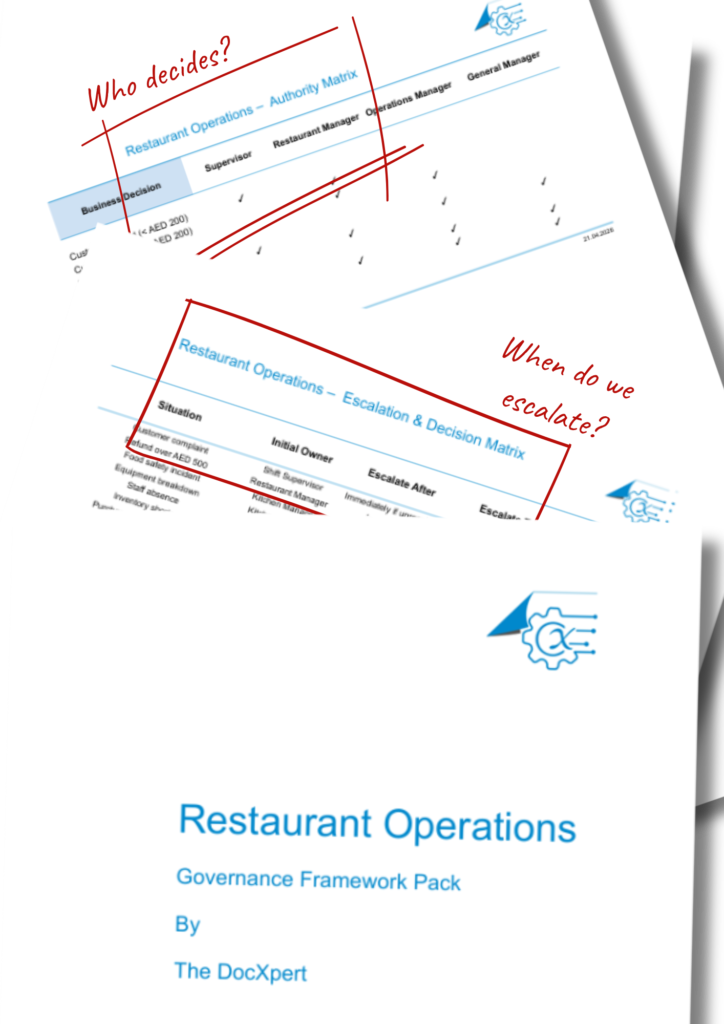
A governance framework isn’t a single document.

It’s a collection of practical tools that define who makes decisions, when approvals are required, and how issues are escalated across the business.

Every governance framework is tailored to the way your organisation operates, helping leaders make better decisions while improving accountability and operational control.

Signs You Need Governance Frameworks

Your business may benefit from governance frameworks if:

  • Managers make different decisions in similar situations.
  • Staff are unsure who has authority to approve important decisions.
  • Leadership is involved in too many day-to-day approvals.
  • Operational issues are frequently escalated unnecessarily.
  • Accountability becomes unclear when problems occur.
  • Decision-making slows as the business grows.

What You’ll Receive

Depending on your organisation, existing structure, and governance priorities, your engagement may include:

Who Benefits from Governance Frameworks?

Governance frameworks are particularly valuable for:

Our Approach

Evaluate

We review how decisions are currently made, where authority sits, how issues are escalated, and where unclear accountability creates delays or operational risk.

Engineer

We design practical governance frameworks that define decision authority, responsibilities, approval pathways, escalation routes, reporting structures, and operational controls.

Elevate

We embed governance into everyday operations so leaders and teams can make consistent decisions, act within clear authority, and remain accountable for outcomes.
What You’ll Receive

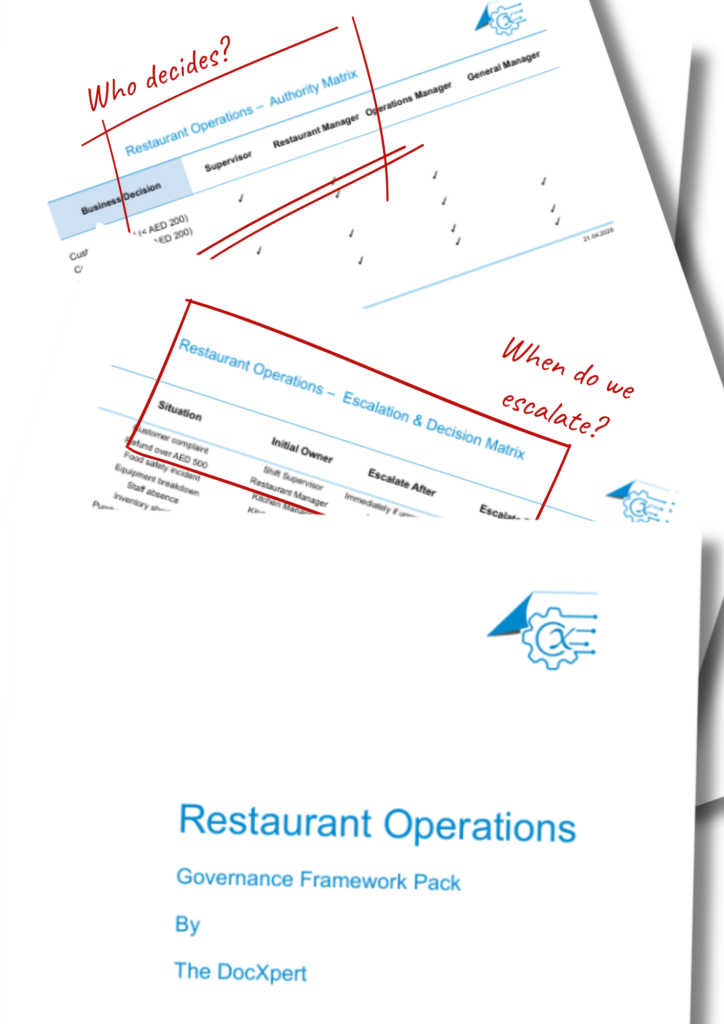
Depending on the role, organisation, and scope of the engagement, your onboarding system may include:

  • Governance Framework
  • Decision Authority Matrix
  • Approval Matrix
  • Escalation Matrix
  • Roles and Responsibilities Matrix
  • RACI Matrix, where appropriate
  • Governance Guidelines
  • Reporting and Oversight Structure
  • Governance Improvement Roadmap
Together, these elements create a practical governance system that clarifies how authority, accountability, oversight, and escalation work across the organisation.

Frequently Asked Questions

What's the difference between governance frameworks and SOPs?
SOPs explain how specific, recurring activities should be performed. Governance frameworks define who has decision-making authority, who is accountable, how approvals and escalations work, and how the organisation maintains appropriate oversight.
Not when it is designed well. Effective governance removes uncertainty by defining who can make decisions, which matters require approval, and when an issue should be escalated. This can reduce unnecessary approvals and prevent routine decisions from repeatedly reaching senior leadership.
Yes. Governance frameworks can support ISO management systems by establishing clear accountability, ownership, oversight, reporting, and decision-making responsibilities. However, the exact governance and documentation requirements depend on the applicable standard, the organisation, and the scope of certification.
A governance framework may include decision-authority matrices, approval pathways, escalation routes, roles and responsibilities, reporting structures, oversight mechanisms, performance reviews, and supporting governance guidelines. The exact components depend on the organisation’s structure and needs.
No. Governance becomes valuable whenever unclear authority or accountability begins to affect decisions and performance. A growing business may need a relatively simple framework, while a larger or more complex organisation may require governance across multiple teams, locations, or management levels.

Governance with Purpose

Governance with PurposeGood governance is not about adding more rules. It is about giving people the clarity to make the right decisions.

When decision authority, accountability, approvals, and escalation routes are clear, people can act with greater confidence and leaders can maintain appropriate oversight without becoming involved in every decision.

Inside a Governance Framework Pack

A governance framework isn’t a single document.

It’s a collection of practical tools that define who makes decisions, when approvals are required, and how issues are escalated across the business.

Every governance framework is tailored to the way your organisation operates, helping leaders make better decisions while improving accountability and operational control.

Signs You Need Governance Frameworks

Your business may benefit from governance frameworks if:

  • Managers make different decisions in similar situations.
  • Staff are unsure who has authority to approve important decisions.
  • Leadership is involved in too many day-to-day approvals.
  • Operational issues are frequently escalated unnecessarily.
  • Accountability becomes unclear when problems occur.
  • Decision-making slows as the business grows.

A 60-minute conversation to clarify how decisions are made across your business.

We’ll review how authority, approvals, accountability, and escalation currently work across your organisation. We’ll identify governance gaps, decision bottlenecks, and unclear responsibilities, then recommend practical next steps for improving decision-making and oversight.

Your review includes

Build Systems That Scale

If your business is becoming harder to manage, it’s time to put the right systems in place.

Assess Your Business Performance​

Take a quick assessment to evaluate your current practices, identify gaps, and receive actionable insights for improving your governance.

Assess the strength, consistency, and effectiveness of your core processes.