As organisations grow, documents spread across shared drives, inboxes, individual devices, and collaboration platforms.
Employees lose time searching for information, create duplicate files, and work from outdated versions. Approvals become difficult to trace, access becomes inconsistent, and nobody is entirely certain which document is authoritative.
A 2022 survey of 1,043 US knowledge workers found that employees spent an average of at least two hours a day—25% of their working week—looking for the documents, information, or people they needed to do their jobs.
The finding illustrates the wider cost of fragmented workplace information.
Source: Glean, Hybrid Workplace Habits & Hangups, survey conducted by The Harris Poll.
When information is fragmented, work is duplicated, decisions are delayed, and employees may rely on documents that are incomplete or out of date. Document management replaces this uncertainty with a controlled system for creating, finding, using, and maintaining business documents.


Document management is the structured process of creating, organising, storing, securing, reviewing, and controlling documents throughout their lifecycle.
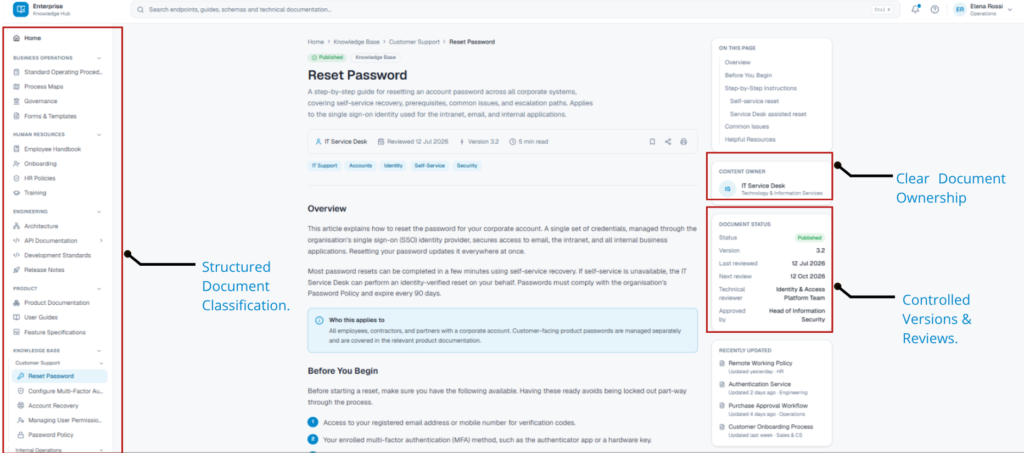
It defines where documents belong, how they are classified, who owns and approves them, who can access them, and when they should be reviewed, archived, or securely disposed of.
A document management framework establishes the structure, controls, responsibilities, and governance needed to manage documents consistently. Technology provides the platform that supports this framework.
Without clear structures and controls, a new document management system can quickly reproduce the same problems that already exist across shared drives and inboxes.
Effective document management brings together information architecture, document control, governance, access permissions, and technology. The result is a dependable information system that helps employees find the right document, confirm that it is current, and use it with confidence.
Give employees a clear and consistent way to locate the documents they need.
Ensure teams can identify the latest approved document without relying on filenames, inboxes, or individual memory.
Protect sensitive information by aligning access with roles, responsibilities, and information sensitivity.
Define who is responsible for reviewing, approving, maintaining, and retiring each document.
Maintain traceable approvals, revision histories, retention rules, and document controls.
Allow teams to work from shared, controlled information instead of creating disconnected copies.

These problems often become more visible during rapid hiring, business expansion, certification, software implementation, or organisational change.
These problems often become more visible during rapid hiring, business expansion, certification, software implementation, or organisational change.
Review existing repositories, working practices, duplication, access controls, and operational risks.
Create a logical structure for organising documents by business function, type, sensitivity, status, or purpose.
Develop consistent conventions that make documents easier to identify, search, sort, and manage.
Define how documents are created, reviewed, approved, published, revised, archived, and withdrawn.
Establish clear ownership, approval responsibilities, and access levels based on genuine business needs.
Define how long documents should be retained and create a controlled plan for cleaning, consolidating, and migrating existing content. We design the structure, controls, responsibilities, and governance that your document management technology needs to support. Whether you use Microsoft SharePoint, Teams, OneDrive, Google Drive, Confluence, Notion, or shared drives, we design the operational structure your chosen platform needs to support. Where appropriate, we improve the way your existing technology is structured and governed before recommending a new platform. The value comes from how effectively the system is organised, controlled, and maintained—not from the technology alone.

Understand the current document environment, identify risks, and establish priorities for improvement.The result is a clear assessment of the existing document landscape and the areas requiring attention. Typical duration: 2–3 weeks

Design the future structure, controls, governance, permissions, and implementation roadmap.The result is a practical document management framework designed around your organisation, people, and technology. Typical duration: 4–10 weeks

Support implementation, migration, employee adoption, and ongoing ownership.The new controls are embedded into everyday work so documents continue to be managed consistently. Typical duration: 2–3 weeks
No.
Cloud storage provides a location for files. Document management defines how those files are classified, named, controlled, reviewed, accessed, retained, and disposed of.
Storage is the technology. Document management provides the structure and controls that make the technology reliable
Document management controls formal files and records throughout their lifecycle.
Knowledge management captures, preserves, and shares the broader expertise people need to perform their work and make decisions.
Document management controls documents. Knowledge management enables organisational learning.
Not necessarily.
Many organisations can significantly improve document management by restructuring and governing platforms they already use, such as SharePoint, Google Drive, OneDrive, or a shared drive.
We assess your current environment before recommending whether new technology is required.
Yes.
We can assess existing content, identify duplication and obsolete files, design a clearer structure, define naming and ownership standards, and develop a controlled migration plan.
This can support the reorganisation of an existing shared drive or preparation for SharePoint, Microsoft 365, or another document platform.
Yes.
Structured document control can support certification, audit readiness, and regulatory compliance through defined approvals, revision histories, retention rules, ownership, and traceability.
The exact controls will depend on the standards and requirements that apply to your organisation. We work with your internal quality, compliance, or legal advisers where specialist interpretation is required.
A focused assessment or departmental solution may take 4–8 weeks.
A complete programme covering evaluation, design, implementation support, and adoption typically takes 8–16 weeks.
Larger programmes involving multiple departments, significant document volumes, permission redesign, or platform migration may take longer.
You will receive a prioritised roadmap outlining the most important improvements.
From there, you can choose to:
Yes.
Many organisations retain us to review document governance, update retention schedules, support new document owners, and adapt controls as business or regulatory requirements change.
Ongoing support helps ensure your document management system remains accurate, reliable, and aligned with the way your organisation works.
Together, we will examine how documents are created, stored, shared, approved, and maintained. We will identify areas of risk or inefficiency and determine the practical improvements needed to create a more reliable document environment.
Every review is confidential, practical, and completely non-binding.
If your business is becoming harder to manage, it’s time to put the right systems in place.

Take a quick assessment to evaluate your current practices, identify gaps, and receive actionable insights for improving your governance.