As organisations grow, information moves across more departments, systems, shared drives, and collaboration platforms.
Without clear ownership and controls, access permissions remain unchanged when roles change, reviews are missed, records are retained without a defined reason, and nobody is certain which information is approved or authoritative.
Employees may be able to find information but still not know whether it is current, reliable, appropriately protected, or safe to share.
Information governance replaces these informal decisions with clear ownership, responsibilities, rules, and proportionate controls.
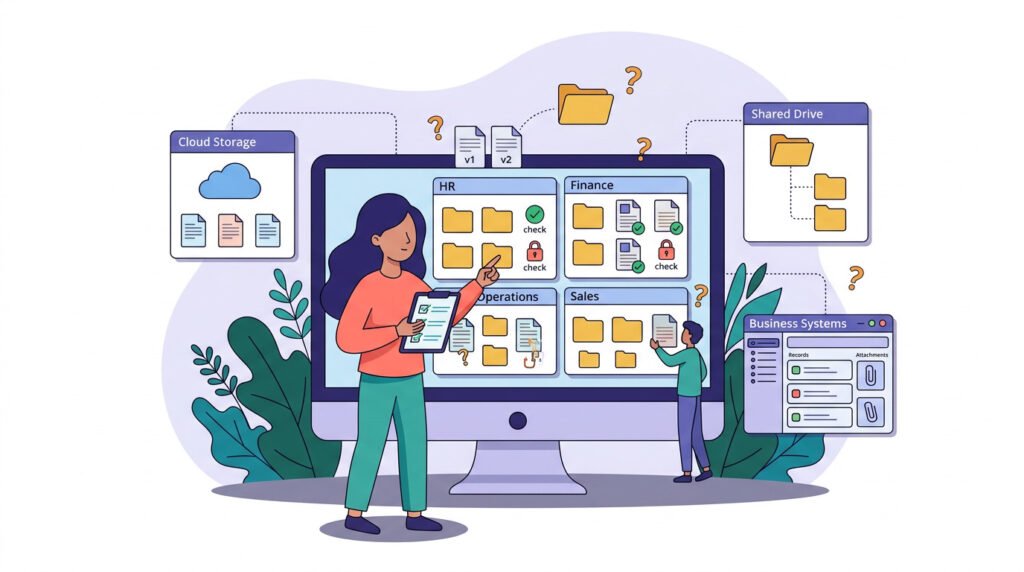

Information governance is the framework of ownership, responsibilities, policies, standards, and controls used to manage business information throughout its lifecycle.
It defines:
Effective information governance applies controls according to the value, sensitivity, purpose, and risk of the information. It strengthens protection and accountability without making every type of information subject to the same level of control.
Information governance is the framework of responsibilities, standards, and controls used to direct and oversee business information throughout its lifecycle.
It defines:
Effective governance applies controls according to the value, sensitivity, purpose, and risk of the information. It strengthens protection where it matters without making everyday work unnecessarily complicated.


Your organisation may need stronger information governance when:
These are not simply document problems. They reveal gaps in how information responsibilities and controls have been defined.
Help employees identify who owns important information, whether it is approved, and when it was last reviewed.
Make ownership and responsibilities visible so people understand who can approve changes and who must keep information current.
Apply classification and access controls according to the sensitivity, value, and purpose of the information.
Establish common standards for ownership, approval, access, review, retention, and disposal across teams and systems.
Maintain clearer records of ownership, approvals, access, reviews, and retention decisions when evidence is required.
The exact deliverables depend on the organisation’s information risks, existing controls, applicable obligations, systems, and governance priorities.
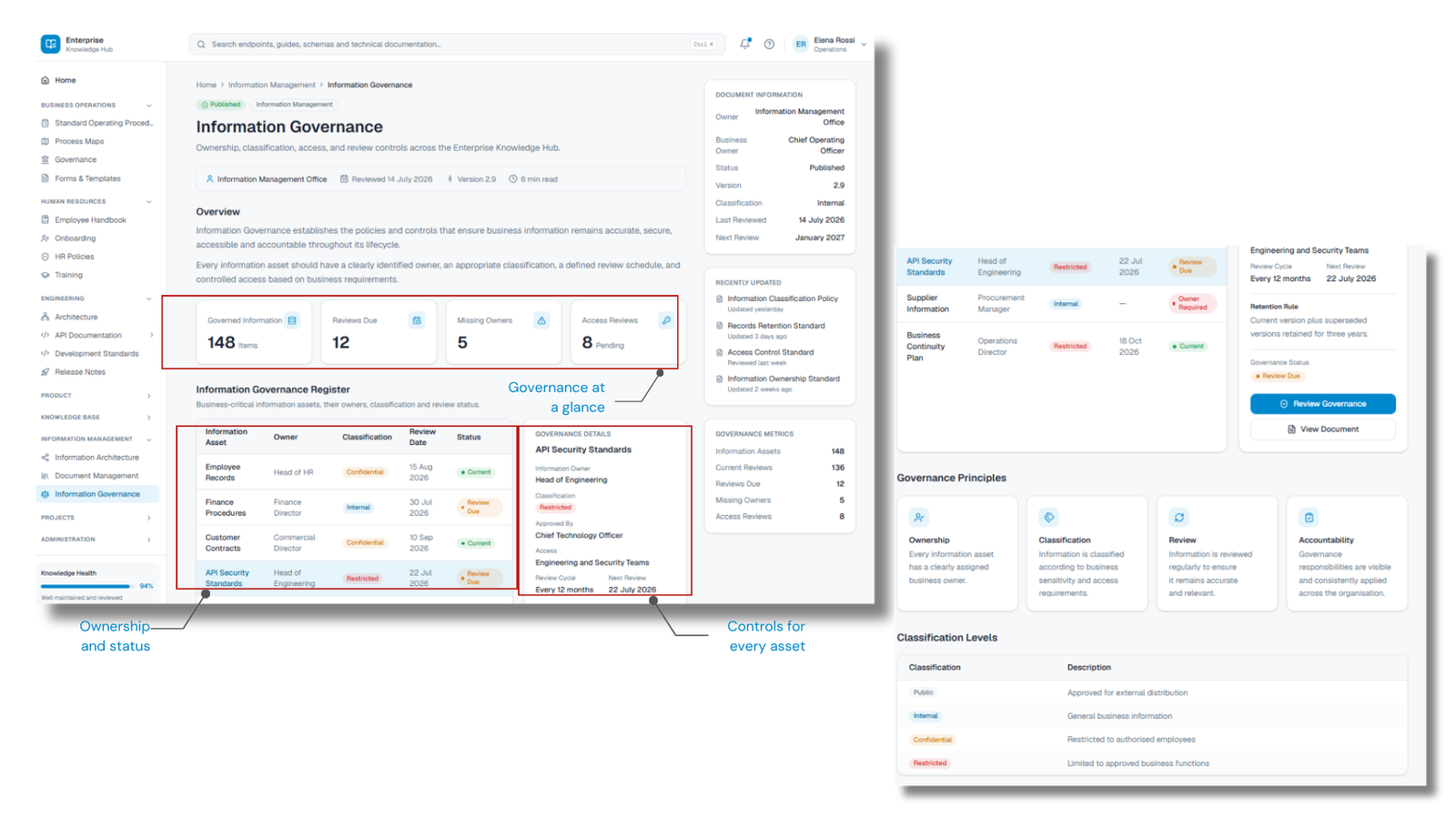
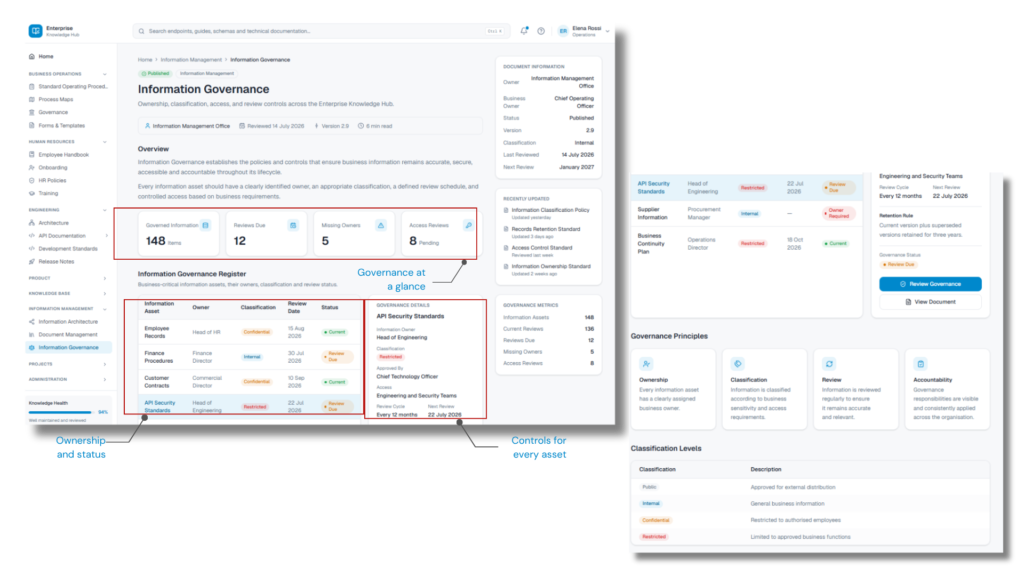
Example of information governance controls showing ownership, approval status, classification, review information, and requirements applied to information assets.
The example shows how information ownership, approval status, access requirements, review dates, retention rules, and other controls can be made visible within the systems employees use.
We design practical information governance frameworks that establish clear ownership, responsibilities, and controls for business information.
Review how information is owned, classified, accessed, approved, retained, and disposed of, and identify the most important governance gaps.
Define the policies, responsibilities, standards, and controls needed to govern information consistently.
Assign owners to critical information assets and define their responsibilities for approvals, reviews, updates, and retention decisions.
Establish appropriate classification levels and define who may view, change, approve, or share each type of information.
Create clear processes for reviewing, approving, updating, and publishing controlled information.
Define how long information should be retained and what should happen when it is no longer required.
Provide practical guidance for introducing the framework across everyday processes, systems, and roles.
We review how important information is owned, classified, accessed, changed, approved, protected, retained, and disposed of, and identify priority risks or control gaps. Typical duration: approximately 2–3 weeks

We design the ownership model, responsibilities, policies, standards, classifications, decision rights, and controls required to govern information consistently. Typical duration: approximately 4–10 weeks, depending on scope

We support implementation, embed responsibilities into everyday work, and establish review, oversight, escalation, and maintenance practices. Typical duration: approximately 2–3 weeks for initial implementation and handover
No. Information management covers the practical processes and systems used to organise, store, find, maintain, share, and use information.
Information governance defines the ownership, decision rights, responsibilities, policies, and controls surrounding that information. Information management handles the information; governance establishes the rules and accountability under which it is managed.
Information architecture determines how information is structured, labelled, classified, connected, searched, and navigated.
Information governance determines who owns the information, who may access or change it, how it is approved and protected, and how long it should be retained.
Information architecture creates the organising structure. Information governance establishes how that structure and its information will be controlled and maintained.
A broader governance framework defines how authority is distributed, decisions are made, responsibilities are assigned, and accountability is maintained across the organisation.
Information governance focuses specifically on the ownership, quality, access, use, protection, retention, and disposal of business information. It may form one part of the organisation’s wider governance framework.
No. Any organisation can experience problems caused by unclear ownership, uncontrolled access, unreliable information, inconsistent approvals, or indefinite retention.
The level of governance should be proportionate to the organisation’s size, complexity, information risks, business needs, and applicable legal or regulatory obligations.
It should not. Effective information governance clarifies recurring decisions and applies stronger controls only where the value, sensitivity, or risk of the information justifies them.
Low-risk information should not necessarily be managed in the same way as confidential, regulated, or business-critical information.
Not necessarily. Ownership, classification, access, approval, review, retention, and disposal requirements should be defined before technology is selected or configured.
Your existing platforms may already support many of the required controls. We assess the current environment before recommending configuration changes or new technology.
You’ll receive prioritised recommendations identifying unclear responsibilities, control gaps, and significant information risks.
From there, you can choose to:
The review does not commit you to a larger engagement.
An information-governance framework may include governance principles, ownership and accountability, classification levels, access rules, approval requirements, information-quality responsibilities, retention schedules, disposal requirements, monitoring, escalation, and supporting procedures.
The exact components depend on the organisation’s information, systems, risks, and applicable obligations.
Yes. Information governance can support audit, certification, legal, and regulatory requirements by establishing ownership, classification, access controls, approval records, retention rules, disposal processes, and traceability.
The exact requirements depend on the applicable standard, regulation, information type, and scope. We work with internal legal, compliance, quality, or specialist advisers where formal interpretation is required.
The timeline depends on the scope, number of information types and systems, existing controls, organisational complexity, and applicable requirements.
A focused governance project may take approximately 4–8 weeks. A broader programme involving several departments, systems, or information categories may take approximately 8–16 weeks and can be delivered in phases.
Yes. Ongoing support can help keep ownership, classifications, access rules, retention requirements, and governance controls aligned with organisational and regulatory changes.
Support may include governance reviews, control updates, owner guidance, quality checks, retention reviews, and improvement planning.
If your business is becoming harder to manage, it’s time to put the right systems in place.

Take a quick assessment to evaluate your current practices, identify gaps, and receive actionable insights for improving your governance.