As organisations grow, their information grows with them.
New systems, teams, services, and working practices are introduced, but the structure connecting their information often develops informally. What once worked for a smaller organisation becomes increasingly difficult to understand and maintain.
Information begins to reflect where it was created rather than how it will be used. Employees see fragments of the business instead of clear connections between its processes, policies, knowledge, documents, and systems.
The problem is not simply where information is stored. It is whether the organisation has a shared logic for arranging it.
Information architecture creates that logic. It provides a consistent way to organise, label, connect, and navigate information across the business.

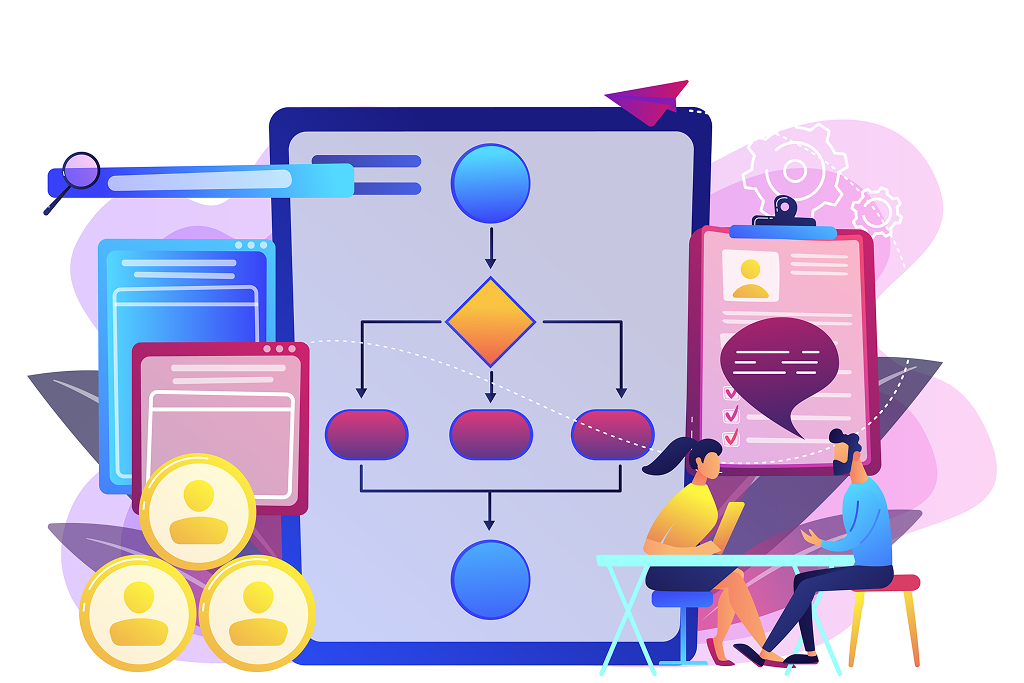
Information architecture is the structured practice of organising and labelling information so people can find, understand, and use it easily.
It defines:
An information architecture may include taxonomies, navigation hierarchies, metadata, naming standards, and relationships between content.
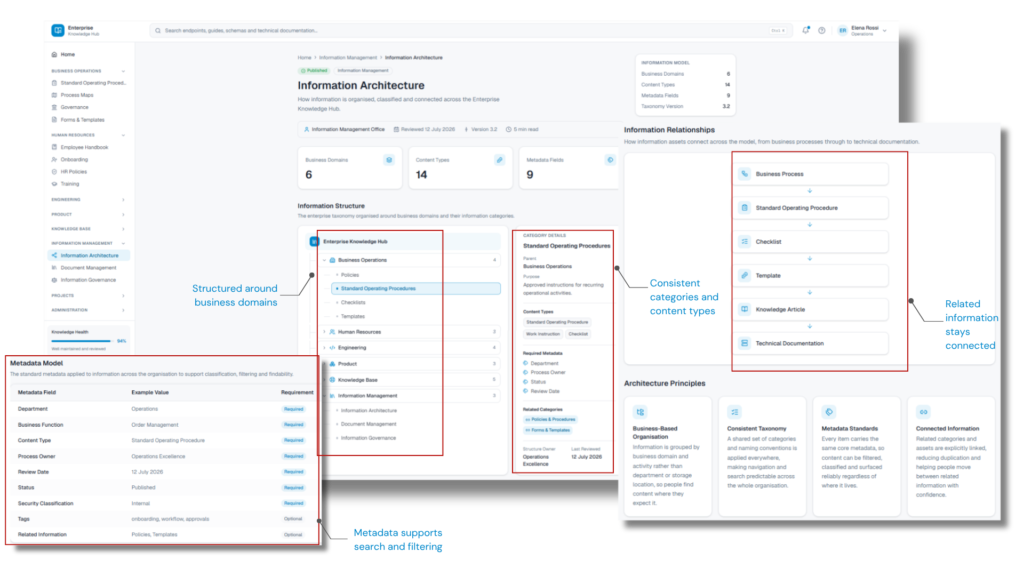
Unlike a folder structure, it considers the complete information environment. It connects documents, processes, policies, knowledge, systems, and resources—even when they are stored across different platforms.
Effective information architecture reflects how people think about their work, not simply how departments or software platforms are arranged.
The result is a structure employees can understand, navigate, and use with confidence.
Give employees clear and predictable paths to the information they need.
Use consistent terminology, categories, and descriptive information to improve search and filtering.
Make existing information easier to discover before employees recreate it elsewhere.
Help people move between related policies, procedures, forms, guidance, and business resources.
Create shared terminology for describing and classifying information across departments.
Add new teams, services, systems, and content without making information harder to navigate.

Your organisation may need a clearer information structure if:
These problems often become more visible during rapid growth, organisational restructuring, system implementation, platform migration, or the development of an enterprise knowledge hub.
Review existing repositories, navigation, categories, terminology, search behaviour, and the barriers preventing employees from finding information.
Identify what information exists, where it is stored, how it is organised, and where duplication, gaps, or inconsistencies occur.
Create a clear system of categories and subcategories so similar information is organised consistently.
Design intuitive navigation paths and establish clear terminology for sections, categories, pages, folders, and content types.
Define consistent metadata fields—such as department, content type, owner, status, review date, and security classification—to support organisation, search, filtering, and maintenance.
Define how categories, labels, metadata, and structural standards will be reviewed and maintained as the business evolves.

Understand what information exists, how it is currently organised, how employees look for it, and where the existing structure creates confusion.The result is a clear assessment of the current information environment and the priorities for improvement. Typical duration: 2–3 weeks

Design a clear system for classifying, connecting, searching, and navigating information.The result is a practical information architecture designed around your organisation, users, and technology. Typical duration: 4–10 weeks

Support implementation, content mapping, migration, employee adoption, and ongoing ownership.The new architecture is embedded into everyday work so information remains organised and easy to find as the business evolves. Typical duration: 2–3 weeks
No.
A folder structure organises files within a particular location.
Information architecture defines how information is grouped, labelled, connected, searched, and navigated. It may include folders, but it also considers categories, metadata, search filters, navigation paths, and relationships between content.
Information architecture determines how information is organised and found.
Document management controls how formal documents are created, reviewed, approved, stored, revised, retained, and disposed of.
Information architecture supports findability. Document management supports control throughout the document lifecycle.
Information architecture determines how information is structured, labelled, classified, and connected.
Information governance defines the policies, responsibilities, and controls used to manage that information.
Architecture creates order. Governance ensures that order is maintained.
No.
Information architecture can be applied to intranets, shared drives, knowledge bases, document repositories, collaboration platforms, technical documentation portals, and other business systems.
Any environment containing information that people need to navigate can benefit from a clear architecture.
Yes.
Effective search depends on more than the search tool. Clear titles, consistent terminology, useful metadata, well-defined categories, and meaningful connections all help search systems return more relevant results.
Information architecture gives search the context it needs.
Yes.
We design information architecture for Microsoft SharePoint, Teams, OneDrive, Google Drive, Confluence, Notion, shared drives, and other business platforms.
Where several platforms are involved, we clarify what information belongs in each system and how users move between them. The objective is not necessarily to store everything in one place, but to create a coherent structure across the organisation.
We assess your existing environment before recommending whether any technology changes are needed.
Yes.
Before content is migrated, decisions must be made about what should move, where it belongs, how it should be classified, and what can be archived or removed.
We can design the future architecture, map existing information to it, and support the development of a controlled migration plan.
A focused project for one repository, department, or knowledge base may take 4–8 weeks.
A broader programme covering several departments, platforms, or large volumes of information typically takes 8–16 weeks.
Projects involving extensive content analysis, stakeholder research, or migration planning may take longer.
You will receive a prioritised roadmap outlining the most important improvements.
From there, you can choose to:
Together, we will examine how information is grouped, labelled, connected, searched, and navigated. We will identify areas of confusion and determine the practical improvements needed to create a clearer information structure.
Every review is confidential, practical, and completely non-binding.
If your business is becoming harder to manage, it’s time to put the right systems in place.

Take a quick assessment to evaluate your current practices, identify gaps, and receive actionable insights for improving your governance.