
Shipping new features is only part of delivering a successful product.
If customers don’t understand what’s changed, why it matters, or how it improves their work, valuable improvements often go unnoticed.
One of the reasons this happens is that release notes are frequently written by developers or subject matter experts. They naturally focus on what changed, while users want to understand why it matters.
Every release is an opportunity to reinforce the value of your product. Well-written release notes translate technical updates into meaningful business benefits, helping users discover new capabilities, adopt new features with confidence, and recognise the continuous improvements that make your product more valuable over time.


Release notes are structured communications that explain what’s new, what’s changed, what’s been fixed, and what users need to know after every software release.
They bridge the gap between your development team and your users by translating technical changes into practical information that helps people understand the value behind each release.
Well-designed release notes don’t simply document software changes. They encourage users to discover new capabilities, adopt new features, and continue getting more value from your product.
Effective release notes become part of your product’s knowledge system, creating a trusted history of product improvements while supporting adoption, reducing support requests, and building customer confidence.
Customers are far more likely to use new functionality when they understand how it improves their work.
Reduce repetitive support enquiries by proactively answering common questions after every release.
Consistent release communication demonstrates that your product is actively maintained and continually improving.
Help customers discover valuable capabilities they may never have found on their own.
Ensure product, engineering, support, sales, and customer success teams communicate every release consistently.
Maintain an organised record of product evolution that users and internal teams can easily reference.
Explain what changed and why it matters.
Every update links to supporting guidance.
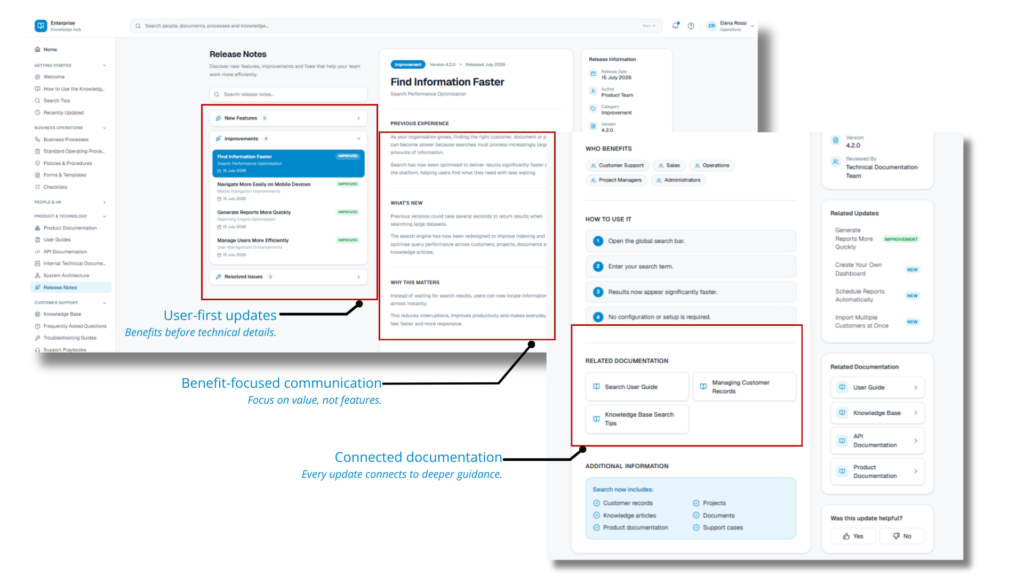
Your release notes could benefit from improvement if:

Effective release notes provide information that different audiences can quickly understand.
Rather than listing every technical change, they communicate the updates that matter most, explain why they matter, and help users confidently adopt new capabilities.
They typically include:
The goal isn’t to document every line of code.
The goal is to help people recognise the value behind every release.


We assess how your organisation communicates product updates, review recent release notes, and identify opportunities to make every release clearer, more consistent, and more valuable to users. Typical duration: 1–2 weeks

We develop release note templates, writing standards, approval workflows, and communication guidelines that ensure every release is accurate, consistent, and valuable to every audience. Typical duration: 2–4 weeks

We help embed release documentation into your software delivery process so every release consistently communicates value and becomes part of your wider documentation ecosystem. Typical duration: Ongoing improvement

Depending on your requirements, a Release Notes engagement may include:
Release notes help customers understand what’s changed, why it matters, and whether they need to take any action. They improve feature adoption, reduce support requests, and demonstrate that your product is actively evolving.
Good release notes explain changes from the user’s perspective, not the developer’s. They communicate what changed, why it matters, and how users benefit from every update.
Most products have multiple audiences, including end users, administrators, customer success teams, support teams, and developers. Effective release notes communicate appropriately for each audience.
A changelog is a chronological record of product changes, often intended for technical audiences. Release notes are curated communications that explain the most important changes in language that users and stakeholders can easily understand.
Yes.
We can integrate release note creation into your existing Agile, Scrum, Kanban, or software delivery workflow without disrupting your development process.
Yes. This is where we add the greatest value.
Release notes are often written by developers or subject matter experts who understandably focus on the features they’ve built or the technical changes they’ve made. While technically accurate, they don’t always explain the benefit those changes bring to users.
We work with product managers, developers, QA teams, and customer success teams to translate technical updates into clear, user-focused communication that explains both what changed and why it matters.
Absolutely. Release notes are most effective when they connect users to user guides, knowledge base articles, API documentation, and product documentation, helping users quickly find more detailed information when they need it.
A focused review and template design typically takes 2–4 weeks. Building a complete release communication framework generally takes 1–2 months, depending on the complexity of your product and release process.
Yes.
We can develop the templates, ownership model, approval workflows, and publishing standards that make release notes a consistent part of every software release.
You’ll receive a prioritised roadmap recommending specific improvements to your release communication process.
From there, you can choose the level of support that suits your needs:
Many software companies begin with a focused release documentation project and then continue on retainer as their product documentation ecosystem grows.
Every review is confidential, practical, and completely non-binding.
If your business is becoming harder to manage, it’s time to put the right systems in place.

Take a quick assessment to evaluate your current practices, identify gaps, and receive actionable insights for improving your governance.