Policies. Procedures. Technical documentation. Product knowledge. Training materials. Customer-support articles. Internal expertise.
Every growing organisation accumulates knowledge, but that knowledge does not automatically become easy to find or use.
As organisations grow, important information often becomes scattered across shared drives, emails, chat conversations, individual documents, and employees’ memories. People spend time searching for answers, repeat questions, or recreate information that already exists.
A well-designed knowledge base brings important information into a structured, searchable system that helps employees, customers, and partners find reliable answers when they need them.


A knowledge base is a structured information system that helps employees, customers, partners, or technical users find trusted answers and guidance.
It brings together information from across the organisation and organises it using clear categories, navigation, search, metadata, and connections between related content.
A knowledge base is more than a collection of articles or a place to store documents. It requires a deliberate structure, content standards, ownership, and maintenance processes so information remains useful and reliable over time.
Make answers to common questions easier for employees and customers to find independently.
Turn recurring explanations into information that can be found and reused.
Give teams access to maintained information that supports more consistent decisions.
Give teams and locations access to the same approved guidance, standards, and processes.
Give new employees a reliable place to find policies, processes, role guidance, and frequently used information.
Capture important organisational knowledge so it does not remain dependent on individual employees.
Use ownership, standards, and review processes to keep information organised and current.
Your organisation may benefit from a knowledge base if:

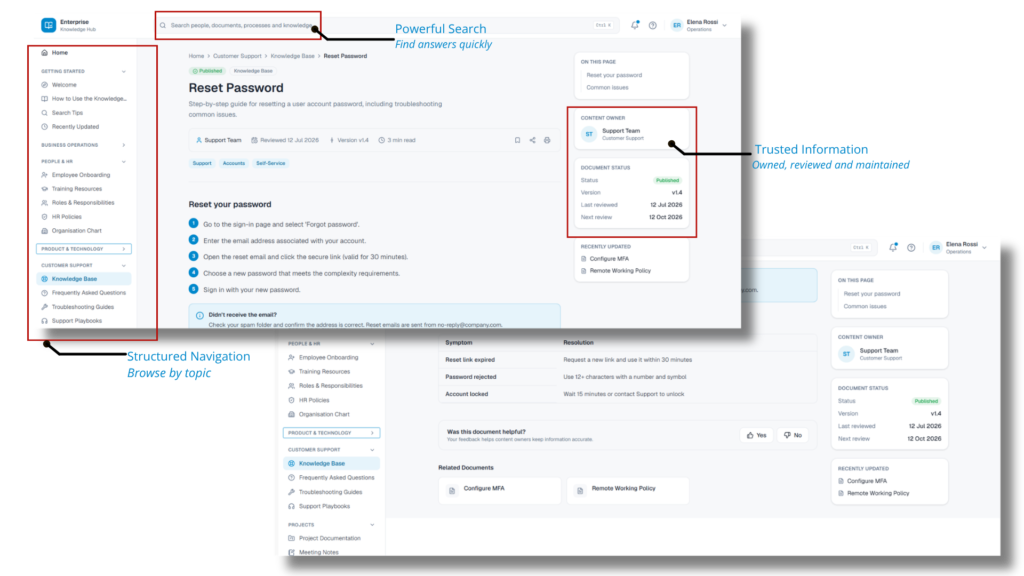
A great knowledge base makes information easy to find, easy to trust, and easy to maintain.
Powerful search, logical navigation, meaningful categories, and connected content help people locate information quickly.
Clear ownership, version control, review schedules, and consistent standards ensure information remains accurate and reliable.
Templates, governance, and a scalable structure keep information organised, current, and easy to update as your organisation grows.

A knowledge base can bring together different types of information within one structured and searchable system. Depending on its audience and purpose, it may include:
Powerful search, logical navigation, meaningful categories, and connected content help people locate information quickly.
Clear ownership, version control, review schedules, and consistent standards ensure information remains accurate and reliable.
Templates, governance, and a scalable structure keep information organised, current, and easy to update as your organisation grows.
A great knowledge base makes information easy to find, easy to trust, and easy to maintain.
Use clear navigation, meaningful categories, search, metadata, and related-content links to help people locate information.
Show ownership, approval status, version information, and review dates so users can judge whether information is reliable.
Use consistent terminology, templates, and writing standards to make content clear and usable.
Link related processes, policies, instructions, technical references, and support content so users can follow the complete information journey.
Organise and present information around the questions and tasks of employees, customers, partners, or technical users.
Define ownership, review cycles, archiving rules, and change processes so the knowledge base can evolve without becoming cluttered or outdated.
Every engagement begins by understanding how knowledge moves through your organisation.

We identify where important knowledge currently exists, how people search for it, where duplication or gaps occur, and which information is most difficult to access or trust.

We design the information architecture, navigation, content types, templates, metadata, and documentation standards that make knowledge easier to organise, find, and use.

We establish ownership, governance, review cycles, and maintenance processes so the knowledge base remains useful as information and organisational needs change.
Documentation consists of individual resources such as user guides, SOPs, policies, technical references, and API documentation.
A knowledge base organises relevant documentation and other forms of knowledge within a searchable information system. It provides the structure, navigation, relationships, ownership, and maintenance processes that make those resources easier to find and use.
A shared drive primarily stores and organises files. A knowledge base organises information around the needs and questions of its users.
Rather than requiring people to know the correct folder or filename, a knowledge base uses navigation, search, categories, metadata, and links between related content to make information easier to discover.
Yes. A knowledge base does not need hundreds of articles before it becomes useful.
You can begin with a defined audience, department, process, or collection of frequently used information. The structure can then be expanded gradually as priorities and content requirements become clearer.
Yes. We design internal knowledge bases for employees and business teams, as well as external knowledge bases for customers, partners, support users, and technical audiences.
The structure, permissions, terminology, and content types should reflect the intended audience and purpose.
Yes. We can assess your existing knowledge base for content quality, duplication, information architecture, searchability, navigation, ownership, and maintenance practices.
We can then improve the areas that are unclear, outdated, duplicated, difficult to find, or no longer aligned with users’ needs.
We design the information architecture and content model around your users and information before adapting them to the selected platform.
We can structure content for platforms such as Confluence, SharePoint, Notion, GitBook, Document360, Zendesk, and other knowledge-base or documentation systems. The exact approach depends on the platform’s capabilities, available access, and your publishing workflow.
We establish clear content ownership, documentation standards, review schedules, approval requirements, and archiving processes.
Content should also be reviewed when products, processes, policies, systems, responsibilities, or regulations change.
The timeline depends on the amount and condition of the existing content, number of audiences, complexity of the information architecture, platform requirements, and availability of subject-matter experts.
A focused knowledge base for one team, audience, or information area may take several weeks. A larger organisation-wide knowledge base is usually delivered in phases over several months.
During the Strategic Review, we’ll recommend a realistic scope, sequence, and timeline based on your priorities, available resources, and the areas where better access to knowledge would create the most immediate value.
You’ll receive prioritised recommendations outlining the most valuable opportunities to improve your knowledge base.
From there, you can choose the level of support that best suits your organisation. We can:
The Strategic Review does not commit you to a larger engagement.
Yes. Ongoing support can help keep the knowledge base aligned with new products, processes, policies, systems, and organisational changes.
Support may include content reviews, article updates, new content, information-architecture improvements, quality assurance, governance support, and coordination with content owners.
The scope and cadence can be matched to your priorities and internal capacity.
If your business is becoming harder to manage, it’s time to put the right systems in place.

Take a quick assessment to evaluate your current practices, identify gaps, and receive actionable insights for improving your governance.