API Documentation

Create API documentation that reduces implementation effort and improves the developer experience.

Make Every Integration Easier

Modern software rarely works in isolation. Whether an API connects an ERP, processes payments, retrieves customer data, or links internal systems, developers need accurate information about how that connection works.

Even a well-designed API can be difficult to implement when its documentation is incomplete, inconsistent, or scattered across specifications, code comments, tickets, and internal knowledge.

Clear API documentation gives developers the technical detail, examples, and guidance they need to understand the API, implement it correctly, and resolve problems with less reliance on your engineering team.


What is API Documentation?

API documentation explains how developers can understand, access, and work with an application programming interface.

It describes the API’s purpose, authentication requirements, endpoints, parameters, request and response structures, error behaviour, constraints, webhooks, and supported versions.

Effective API documentation combines accurate reference information with practical guidance and examples so developers can move from initial evaluation to implementation and ongoing maintenance.

What Effective API Documentation Covers

API Overview

Introduce the API, its purpose, and the problems it solves so developers understand where to begin.

Authentication

Help developers connect securely without unnecessary trial and error.

Getting Started

Provide a clear path to making the first successful API request.

Endpoint Reference

Document every endpoint consistently so developers know exactly how each request behaves.

Request & Response Examples

Provide practical examples that developers can adapt quickly during implementation.

Error Handling

Explain error codes, common causes, and recovery steps that reduce support requests.

Constraints & Usage Limits

Document rate limits, pagination, supported formats, payload limits, and other implementation requirements.

Webhooks

Describe available events, payloads, and delivery behaviour where applicable.

Versioning

Clearly communicate supported versions, deprecated functionality, and breaking changes.

Where Better API Documentation Makes a Difference

The Business Impact of Better API Documentation

The Business Impact of Better API Documentation

Fewer Repeated Support Queries

Help developers find answers without contacting engineering or support for routine integration questions.

Clearer Customer Onboarding

Give customers and partners a more structured path from initial access to their first successful request.

More Consistent Integrations

Provide shared technical guidance that reduces interpretation and inconsistent implementation.

Shorter Implementation Cycles

Make requirements, examples, constraints, and error behaviour easier to understand during development.

Stronger Release Support

Communicate new endpoints, changes, deprecations, and migration requirements clearly.

Better Developer Experience

Make the API easier to evaluate, understand, integrate, troubleshoot, and maintain.

Signs Your API Documentation Needs Improvement

  • Developers regularly contact your team with integration questions.
  • Documentation no longer reflects the current API.
  • Authentication or permission requirements are unclear.
  • Request and response examples are missing or outdated.
  • Error messages explain what happened but not how to resolve it.
  • Rate limits, pagination, payload limits, or other constraints are undocumented.
  • Information is scattered across tickets, code comments, specifications, and internal documents.
  • New features are released without updated documentation.
  • Integration projects repeatedly take longer than expected.

Who Benefits from API Documentation?

  • SaaS companies helping customers and partners integrate with their platforms
  • CTOs and engineering leaders reducing repeated implementation support
  • Software engineering teams maintaining a reliable technical reference
  • Product managers coordinating API releases and product documentation
  • Customer success and support teams resolving integration questions
  • Integration partners building and maintaining connections between systems

Before & After Workflow Optimisation

The Business Impact of Better API Documentation

Signs Your API Documentation Needs Improvement

Well-designed API documentation benefits more than developers. It helps your business:
What You’ll Receive

Depending on your API, intended users, technical environment, and publishing platform, your documentation may include:

Core Documentation

  • API Overview
  • Authentication Guide
  • Getting Started Guide
  • Endpoint Reference

Developer Guidance

  • Request and Response Examples
  • Parameter Descriptions
  • Error Handling
  • Rate Limits and API Constraints
  • Pagination Guidance

Supporting Information

  • Webhook Documentation, where applicable
  • Versioning Guidance
  • Changelog Structure
  • Related Endpoint References
Documentation can be prepared for a developer portal, documentation website, knowledge base, repository, or integrated documentation platform, depending on your technical environment.

What You Receive

Every engagement is tailored to your API, your developers, and the way your documentation will be published.

A typical API documentation project includes:

Core Documentation

Developer Guidance

Supporting Information

Documentation can be delivered as a developer portal, documentation website, knowledge base, or integrated documentation platform, depending on your product and technical environment.

Our Approach

Evaluate

We review your API, specifications, existing documentation, intended users, publishing environment, and the questions or difficulties developers encounter during integration.

Engineer

We structure and write the documentation using consistent terminology, accurate reference content, practical examples, and navigation designed around developer tasks.

Elevate

We validate the documentation with your technical team, prepare it for publication, and establish an approach for keeping it aligned with future API changes.

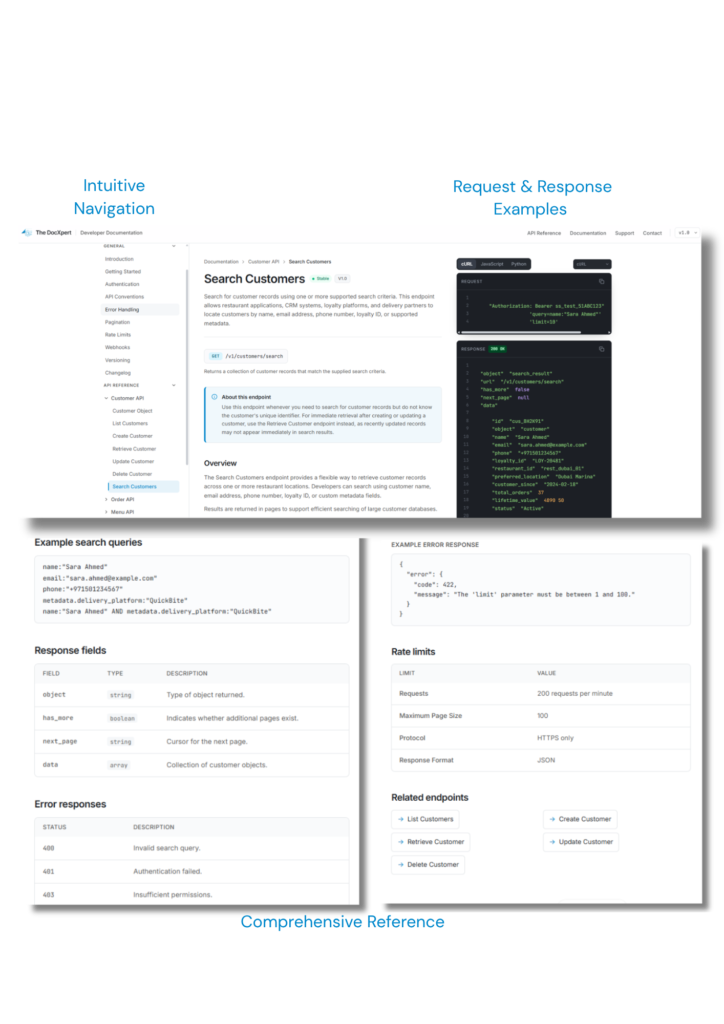
See API Documentation in Action

The example below illustrates how well-structured API documentation helps developers understand an endpoint, prepare a request, interpret the response, and integrate with confidence.

Highlighted features

Frequently Asked Questions

Can you document an existing API?
Yes. We can document an existing API even when its documentation is incomplete, outdated, or does not yet exist. We work from available technical sources and validate the resulting documentation with the appropriate members of your engineering or product team.
Yes. We can assess your existing documentation for completeness, accuracy, structure, terminology, usability, and alignment with the current API. We can then revise the areas that are unclear, inconsistent, outdated, or missing without rebuilding everything unnecessarily.
Yes. Our work combines technical-writing expertise with a software-engineering background. This helps us understand technical concepts, communicate effectively with development teams, and translate implementation details into documentation developers can use. Technical accuracy is confirmed with the relevant subject-matter experts.
Yes. We collaborate with developers, architects, product managers, and technical leads to understand the API, resolve gaps or inconsistencies, review technical content, and confirm that the published documentation reflects the intended implementation.
Yes. An OpenAPI or Swagger specification is helpful, but it is not always essential. Depending on what is available, we can work from source code, Postman collections, existing tests, developer walkthroughs, technical discussions, tickets, and implementation material. Access to appropriate technical reviewers is important for validating the final content.
We support documentation for REST APIs, OpenAPI or Swagger specifications, GraphQL APIs, webhooks, and other common integration technologies. The documentation approach is tailored to the API design, available technical sources, intended users, and publishing platform.
Yes, where the API specification and publishing platform support it. We can structure content for developer portals and documentation tools that provide interactive API reference features, such as testing requests or exploring endpoints from the documentation.
Yes. Documentation can be developed alongside the API. Starting early can surface unclear behaviour, missing examples, inconsistent terminology, and other information gaps before release. The documentation should then be reviewed and updated as the implementation changes.

Yes. We offer ongoing documentation support to keep API references, examples, version information, deprecation notices, and related release documentation aligned with product changes.

The maintenance approach can be matched to your release cycle and internal workflow, whether updates are required periodically or as part of each release.

Build with Confidence

An API is only as useful as a developer’s ability to understand and implement it.

Clear documentation turns technical capability into something developers can evaluate, integrate, troubleshoot, and maintain with confidence.

Book a Strategic Review

A 60-minute conversation to identify where your API documentation is helping - or hindering - developers.

We’ll review your existing API documentation, intended users, technical sources, and publishing environment. We’ll identify gaps that affect understanding, integration, and maintenance, then recommend practical priorities for improvement.

Your review includes

Build Systems That Scale

If your business is becoming harder to manage, it’s time to put the right systems in place.

Assess Your Business Performance​

Take a quick assessment to evaluate your current practices, identify gaps, and receive actionable insights for improving your governance.

Assess the strength, consistency, and effectiveness of your core processes.