



As businesses grow, maintaining consistent ways of working becomes increasingly difficult.
Different employees may perform the same tasks in different ways. Knowledge often remains with experienced team members, while new employees learn through observation rather than clear, documented guidance.
Standard Operating Procedures (SOPs) turn informal ways of working into clear, structured instructions that help employees perform recurring activities consistently.
The result is improved quality, reduced operational risk, faster onboarding, and a business that becomes less dependent on individual knowledge.
SOP development is the process of creating clear, practical instructions that explain how specific, recurring business activities should be performed.
Effective Standard Operating Procedures do more than document individual tasks. They establish an agreed method, clarify responsibilities, define decision points, and explain the standards employees are expected to follow.
As part of a broader business system, SOPs support operational consistency, employee onboarding, quality management, governance, and sustainable growth.
Ensure recurring activities are performed using an agreed and repeatable method across your business.
Give new employees clear guidance on how recurring activities should be performed.
Reduce variation, minimise errors, and improve the consistency of everyday operations.
Capture critical operational knowledge before it is lost when employees change roles or leave the business.
Define responsibilities so everyone understands who performs each activity and who is accountable.
Make operational knowledge easier to retain and transfer as your organisation grows and changes.
Your business may benefit from Standard Operating Procedures if:
The same task produces different results depending on who completes it.
New team members learn by shadowing colleagues instead of following documented procedures.
Critical operational knowledge leaves with employees instead of remaining with the business.
Without standard procedures, maintaining consistency becomes increasingly difficult.
Expanding your business, implementing new software, opening new locations, or preparing for ISO often requires documented operating procedures.

We review how work is currently performed, identify existing documentation, and understand how operational knowledge is shared throughout your business.

We develop practical Standard Operating Procedures that define responsibilities, document the agreed way of working, and provide clear instructions employees can follow.

We organise your SOPs within a structured business system so they remain accessible, controlled, easy to maintain, and aligned with how the business operates.
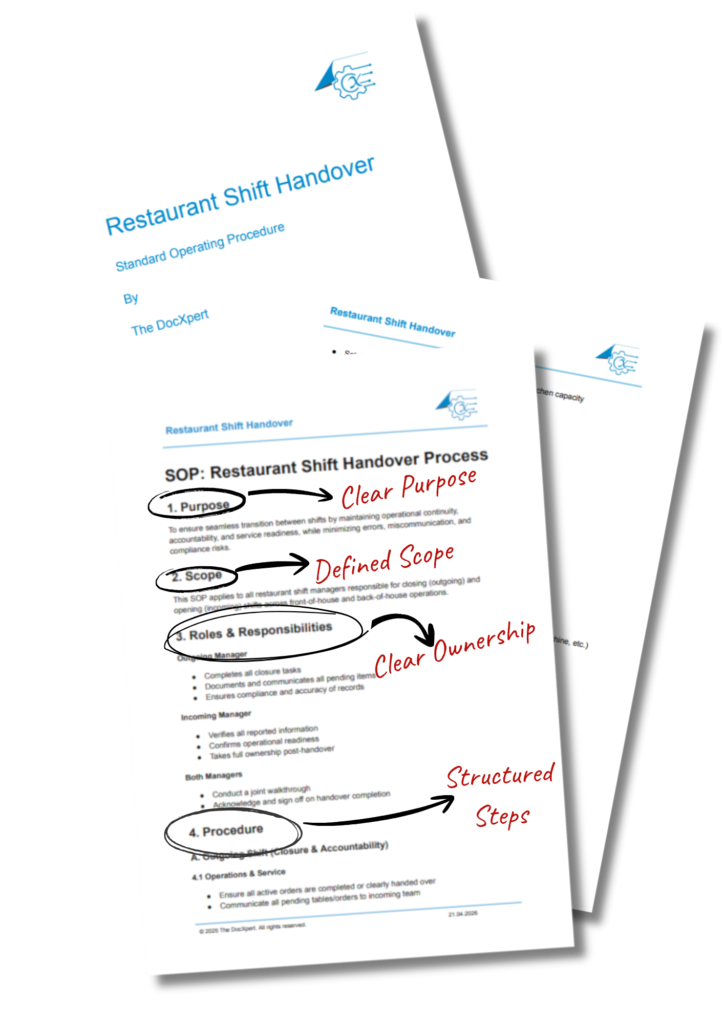
Depending on the process, level of detail, and purpose of the engagement, your SOP documentation may include:
Every business is different, but effective Standard Operating Procedures share the same foundations: clarity, accountability, consistency, and control.
Yes.
Well-structured SOPs can form an important part of an ISO management system or other compliance framework by defining how controlled activities should be performed. However, the documentation required depends on the applicable standard, the organisation, and the scope of certification. SOPs should accurately reflect how the business operates rather than being created solely to satisfy an audit.
If your business is becoming harder to manage, it’s time to put the right systems in place.
Take a quick assessment to evaluate your current practices, identify gaps, and receive actionable insights for improving your governance.