As organisations grow, information moves across departments, systems, shared drives, and collaboration platforms.
Documents are created without clear owners. Access permissions remain unchanged when roles change. Reviews are missed. Records are retained because nobody knows what should be archived or deleted.
Employees may be able to find the information—but still not know whether it is approved, current, secure, or theirs to change.
Information governance replaces these informal decisions with clear responsibilities and consistent controls.


Information governance is the framework of responsibilities, standards, and controls used to direct and oversee business information throughout its lifecycle.
It defines:
Effective governance applies controls according to the value, sensitivity, purpose, and risk of the information. It strengthens protection where it matters without making everyday work unnecessarily complicated.
Information governance is the framework of responsibilities, standards, and controls used to direct and oversee business information throughout its lifecycle.
It defines:
Effective governance applies controls according to the value, sensitivity, purpose, and risk of the information. It strengthens protection where it matters without making everyday work unnecessarily complicated.

Your organisation may need stronger information governance when:
These are not simply document problems. They reveal gaps in how information responsibilities and controls have been defined.
Employees can identify who owns important information, whether it is approved, and when it was last reviewed.
Ownership and responsibilities are visible, making it clear who can approve changes and who must keep information current.
Classification and access controls reduce unnecessary exposure of confidential and restricted information.
Common standards for ownership, approval, access, and retention can extend across teams, systems, and locations.
Clear records of ownership, approvals, access, and retention decisions make evidence easier to locate and demonstrate.
Employees can identify who owns important information, whether it is approved, and when it was last reviewed.
Ownership and responsibilities are visible, making it clear who can approve changes and who must keep information current.
Classification and access controls reduce unnecessary exposure of confidential and restricted information.
Common standards for ownership, approval, access, and retention can extend across teams, systems, and locations.
Clear records of ownership, approvals, access, and retention decisions make evidence easier to locate and demonstrate.
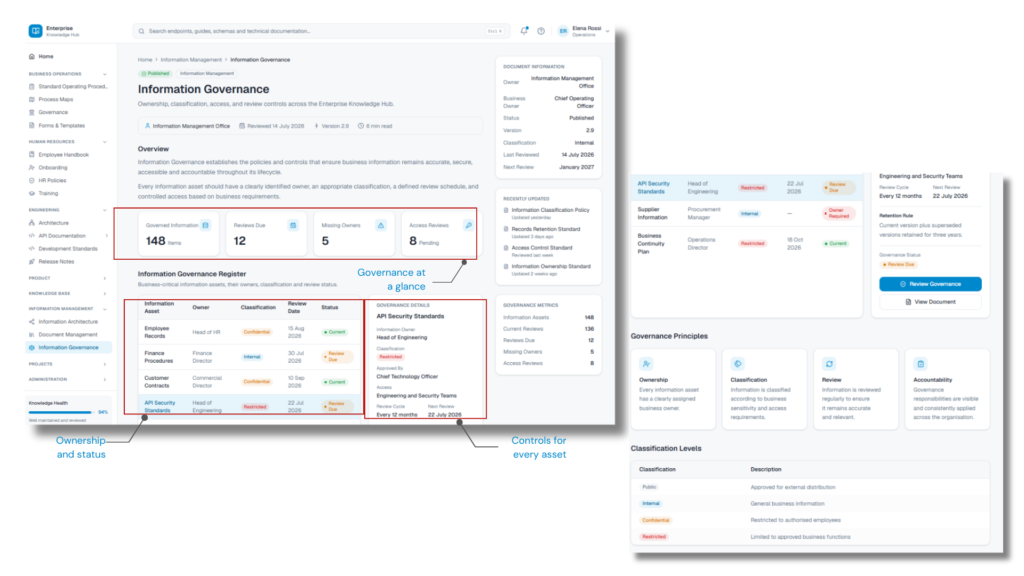
We design practical information governance frameworks that establish clear ownership, responsibilities, and controls for business information.
Review how information is owned, classified, accessed, approved, retained, and disposed of, and identify the most important governance gaps.
Define the policies, responsibilities, standards, and controls needed to govern information consistently.
Assign owners to critical information assets and define their responsibilities for approvals, reviews, updates, and retention decisions.
Establish appropriate classification levels and define who may view, change, approve, or share each type of information.
Create clear processes for reviewing, approving, updating, and publishing controlled information.
Define how long information should be retained and what should happen when it is no longer required.
Provide practical guidance for introducing the framework across everyday processes, systems, and roles.
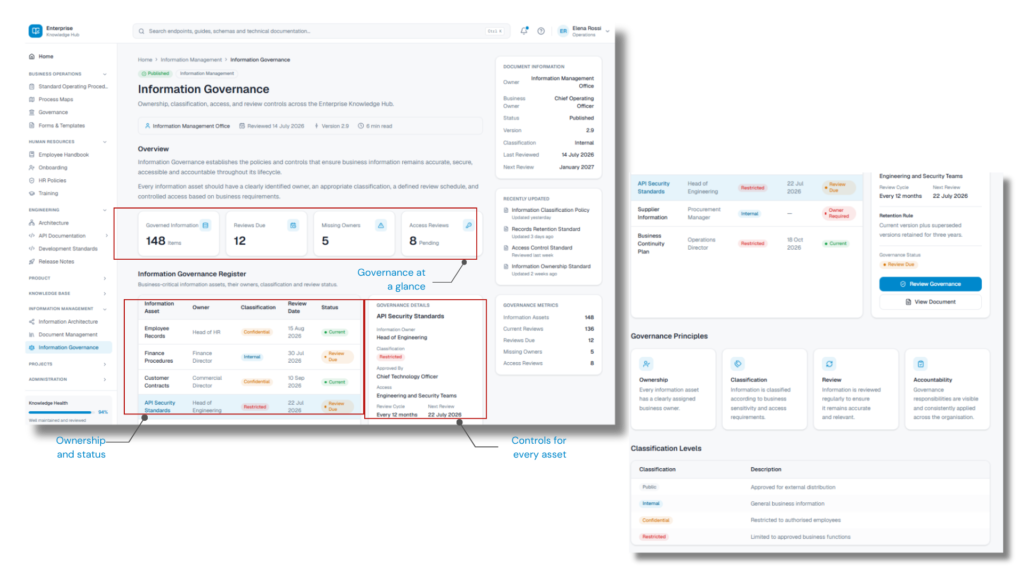
We examine how information is owned, approved, accessed, protected, reviewed, retained, and disposed of. Typical duration: 2–3 weeks

We design the responsibilities, standards, and controls needed to govern information consistently. Typical duration: 4–10 weeks

We embed the framework into everyday work through practical guidance, implementation support, and ongoing oversight. Typical duration: 2–3 weeks
No. Information management covers how information is organised, stored, found, maintained, and used.
Information governance defines the ownership, responsibilities, rules, and controls surrounding that information.
Information architecture determines how information is structured, labelled, and connected so people can find and understand it.
Information governance determines who owns that information, who may access or change it, how it is approved, and how long it should be retained.
Broader governance defines how decisions are made, authority is assigned, and accountability is maintained across the organisation.
Information governance focuses specifically on the ownership, use, protection, retention, and disposal of business information.
No. Organisations of every size benefit from clear responsibility for important information.
The level of governance should reflect the organisation’s size, complexity, risks, and applicable obligations.
It should not.
Good governance simplifies recurring decisions and applies stronger controls only where the value or risk of the information justifies them.
Not necessarily.
Ownership, access, approval, classification, and retention requirements should be defined before technology is selected or configured. Existing platforms may already support many of the controls you need.
You will receive a prioritised roadmap identifying unclear responsibilities, control gaps, and information risks.
You can then develop the complete framework, address high-risk areas first, focus on a specific requirement, or introduce improvements gradually across the organisation.
Every review is confidential, practical, and completely non-binding.
If your business is becoming harder to manage, it’s time to put the right systems in place.

Take a quick assessment to evaluate your current practices, identify gaps, and receive actionable insights for improving your governance.