Hospitality is a live performance.
It’s bright lights and sharp knives and hot plates and smiling through the stress. It’s a room full of strangers who want to feel like they belong. It’s timing, rhythm, energy, and recovery.
And some nights it feels like magic.
The team is in sync. The kitchen is steady. The floor is smooth. Guests are happy. You’re proud. You think, yes, this is why we do it.
Then the next night happens.
Someone calls in sick. A delivery is late. The printer jams. A guest has an allergy question no one expected. The POS freezes. A table complains loudly. Another table watches you deal with it. Your staff starts making eye contact that says, please help.
And suddenly you’re not running a service.
You’re putting out fires.
If you’ve lived this, you’re not alone. And you’re not failing. You’re just doing hospitality the way most people do it.
Which is to say, you’re trying to make art in a world that demands systems.
And here’s the truth that hurts a little, but helps a lot.
Consistency is not created by hustle.
It’s created by process.
Not the boring kind. Not the corporate kind. The kind that makes it possible for real humans to deliver real care, even when everything is messy.
This is a framework to help you get there.
Hospitality is high emotion and high speed.
You’re juggling guests, staff, timing, inventory, prep, payments, reservations, mistakes, moods, and expectations.
And you’re doing it all in public.
There is no backstage. Or rather, the backstage is still visible. The guests can sense it when you’re scrambling. They feel it when the team is unsure. They hear it in the silence when someone is trying to figure out what to do next.
So when your processes are unclear or undocumented, people do what humans do.
They improvise.
Improvisation can look like flexibility. It can even look like talent. It can be charming.
Until it becomes the only way the place runs.
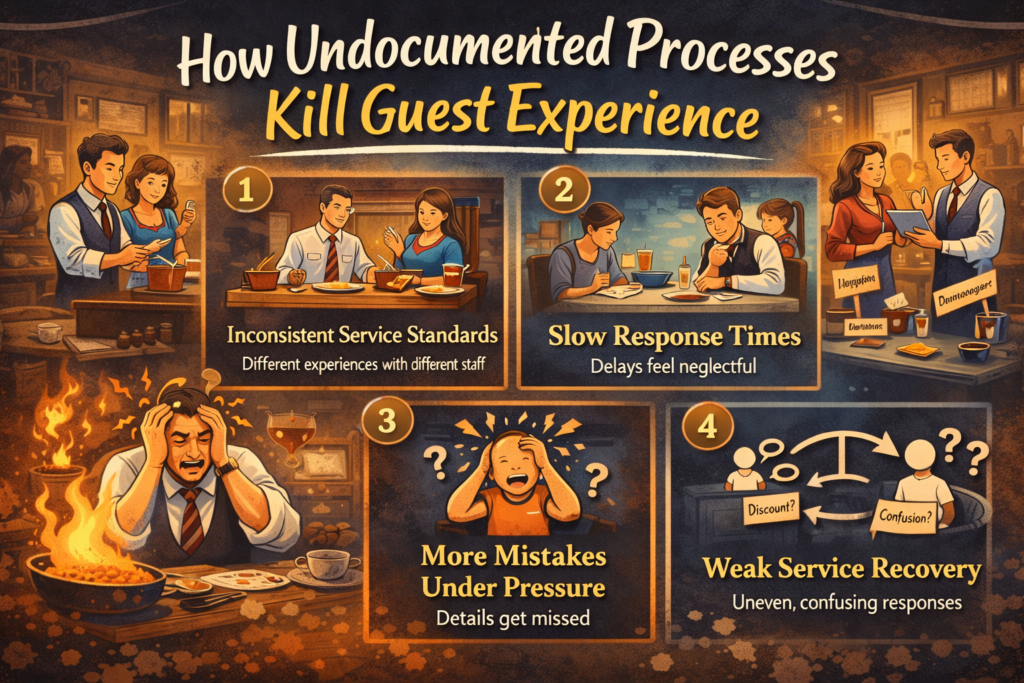
Then it turns into inconsistency. And inconsistency shows up as stress, mistakes, delays, and guests who leave feeling like they were not fully held.
Let’s be honest. Things will go wrong.
The goal is not to build a world where problems never happen.
The goal is to build a world where problems happen and your team still knows what to do.
Predictability is a gift.
It’s a gift to the guest, because they feel safe.
It’s a gift to the team, because they feel capable.
It’s a gift to you, because you stop carrying the entire business on your back.
Most teams try to fix everything at once. That’s usually just another form of panic.
Start smaller. Start honestly.
Ask:
If you listen closely, the answers are already there.
They live in the eye rolls.
They live in the “not again” moments.
They live in the quiet resentment of people who are trying their best inside a system that makes their best feel impossible.
Common chaos points are usually:
Pick the top three. Start there.
This is where it gets clearer.
Not everything needs the same kind of process.
SOPs are for repeatable tasks. The things that should happen the same way every time.
Examples:
Playbooks are for the moments that change fast. The moments where people need decision support, not just instructions.
Examples:
Here’s the simplest way to put it.
SOPs standardise execution.
Playbooks standardise decision-making.
Both matter. Both are love.
Processes fail when they are built in imagination.
The real work is on the floor.
Watch a shift. Watch the handoffs. Watch where people hesitate.
Look for:
You are not looking for blame. You are looking for friction.
Friction is your teacher.
You don’t need a 40-page manual.
You need a clear minimum standard that makes the guest experience stable.
A strong minimum standard includes:
For example, “reset the table” is not a process.
A process is:
Clarity is kindness.
Here’s where a lot of businesses lose the plot.
They create documentation that looks impressive, but never gets opened.
Your documentation needs to be:
A strong SOP can be:
A strong playbook can be:
Documentation is not about controlling people. It’s about supporting them.
Most training is too theoretical.
People read something once, nod, and then forget it the moment service gets loud.
Train like you’re rehearsing a show.
Do:
Small repetition beats big speeches.
Processes die when they become frozen.
Hospitality is a living thing. Your systems should be alive too.
Set a rhythm:
The question stays simple.
What is causing friction right now?
What can we simplify or clarify?
That’s it.
That’s the work.
When this framework starts working, you feel it.
New staff settle in faster.
Managers stop running on panic.
The team stops guessing.
The guest experience becomes smoother.
And the most surprising part is this.
Consistency doesn’t make hospitality less human.
It makes it more human.
Because when your team is not scrambling, they can actually connect. They can notice the guest who looks tired. They can catch the small details. They can be present.
That is the whole point.
If your operation only runs smoothly when the “right person” is on shift, you don’t have a process.
You have dependence.
And dependence is exhausting.
The goal is not to remove personality from service.
The goal is to make great service repeatable.
That’s how you move from chaos to consistency.
If you want help building SOPs and playbooks your team will actually use, The DocXpert can help.