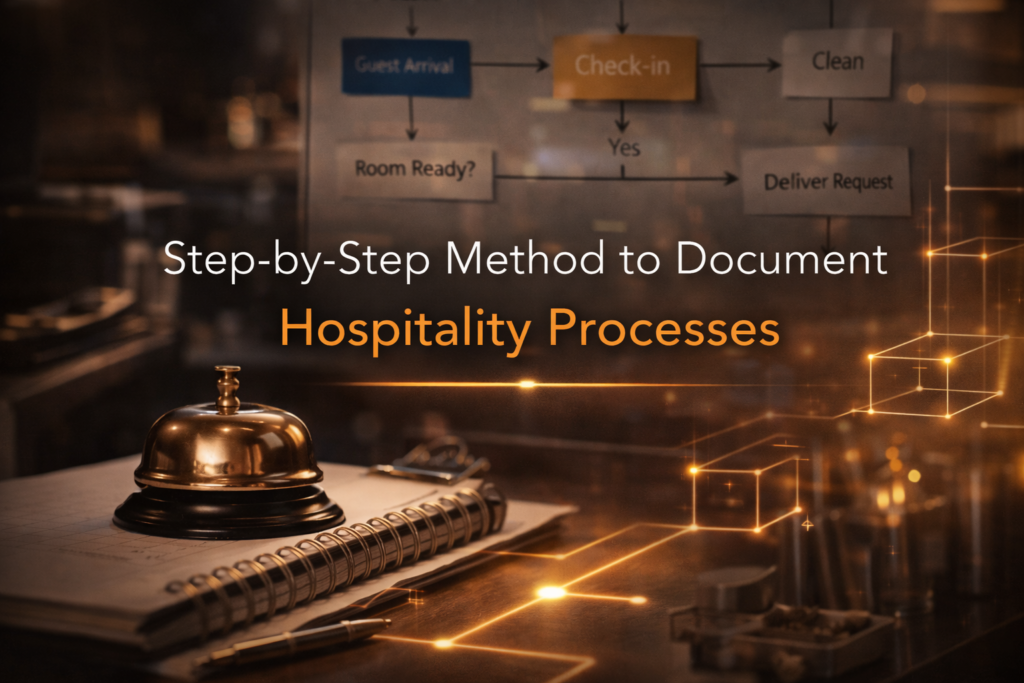
In hospitality, service happens in real time. Guests do not experience intentions. They experience execution.
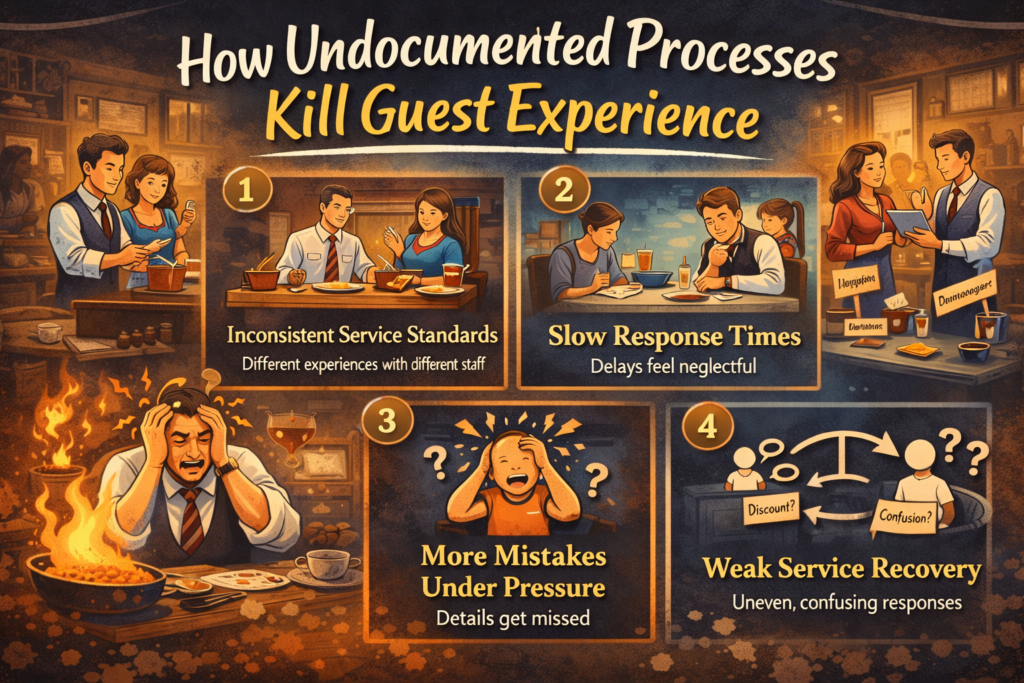
That’s why documenting hospitality processes is critical. Without clear systems, service becomes inconsistent, reactive, and dependent on memory.
Strong hospitality process documentation helps hotels deliver consistent guest experiences, improve efficiency, and scale service standards across teams and shifts.
Here is a practical step-by-step method you can use.
Why Process Documentation Matters in Hospitality
Before diving into the steps, understand the impact.
Clear documentation helps hotels:
- Improve service consistency
- Reduce training time
- Minimise operational errors
- Strengthen accountability
- Scale operations without lowering standards
Hotel operations are complex. Front desk, housekeeping, maintenance, food and beverage, and management must move together. Clear processes keep everyone aligned.
Step 1: Define the Guest Experience You Are Protecting
Start with the outcome. What should the guest consistently feel at this touchpoint?
For example:
- Speed
- Warmth
- Recognition
- Discretion
- Personalization
If you are documenting the hotel check-in process, your objective might be:
“A seamless arrival completed within five minutes where the guest feels recognized and welcomed.”
This keeps the process anchored to the guest experience — not just tasks.
Without clarity here, hotel SOPs become mechanical.
Step 2: Identify the Process Trigger
Every workflow begins with a trigger. In hospitality, that trigger is often guest-driven.
Common examples:
- A guest arrives at the front desk
- A room service order is placed
- A maintenance issue is reported
- An early check-in request is received
- Housekeeping marks a room as cleaned
Document the exact starting point. Clear triggers prevent overlap and confusion.
Step 3: Map the Current Workflow
Next, observe what actually happens — not what is supposed to happen.
Talk to staff across departments and shifts. Identify:
- What happens first
- Who performs each step
- Where information is recorded
- Where decisions are made
- Where delays occur
- Where workarounds exist
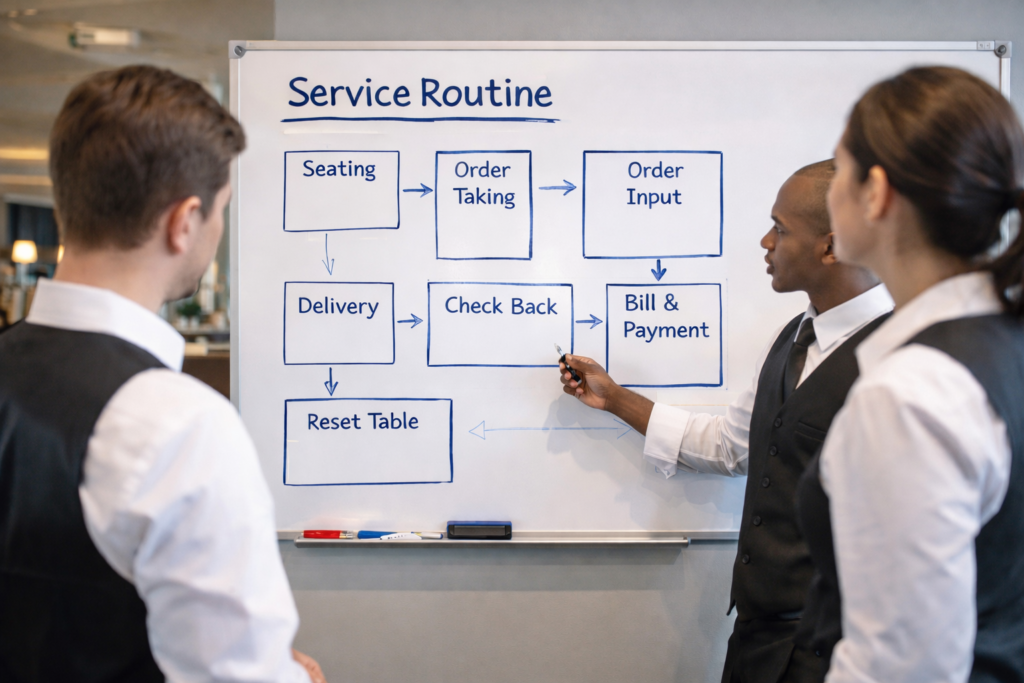
Keep it simple. A flowchart is often more effective than long paragraphs.
Visual process maps expose gaps quickly.
Step 4: Define Roles and Ownership
Most hospitality breakdowns happen during handoffs.
Instead of writing:
“Housekeeping is notified.”
Be precise:
“Front Desk updates room status in the PMS and sends a notification to the Housekeeping Supervisor.”
Clear ownership reduces ambiguity. Less ambiguity means more consistency.
Step 5: Clarify Decision Points
Hospitality is dynamic. Rooms are not always ready. Guests arrive early. Staffing changes.
Your documentation should outline decision paths clearly:
- If the room is ready → Issue the key and confirm amenities
- If the room is not ready → Offer luggage storage and provide an estimated time
- If the delay exceeds 30 minutes → Offer a beverage voucher
Clear decision trees allow staff to act confidently without waiting for approval.
That improves both speed and guest satisfaction.
Step 6: Standardise the Expected Outcome
Every process must end with a measurable result.
Examples:
- Guest request resolved within 15 minutes
- Room status updated within 5 minutes of cleaning completion
- Maintenance ticket closed only after guest confirmation
- VIP arrival completed without waiting
Defined outcomes create accountability. Without them, processes drift.
Step 7: Make SOPs Visual and Accessible
Thick manuals are rarely opened during peak occupancy.
Instead, use:
- Flow diagrams in back-office areas
- Service blueprints for leadership
- Quick reference guides for frontline staff
- Digital SOP libraries within your PMS
If staff cannot access the process quickly, they will not follow it.
Step 8: Test During Live Operations
A process that works on paper may fail during peak check-in.
Test your documentation under real conditions:
- High occupancy
- Group arrivals
- Staff shortages
- System slowdowns
Adjust based on reality. Practical processes survive. Theoretical ones do not.
Step 9: Train Through Scenarios
Avoid reading procedures aloud.
Instead, simulate real situations:
“A VIP guest arrives early and their suite is not ready. What happens next?”
Scenario-based training builds speed and confidence.
Confidence strengthens consistency.
Step 10: Review and Improve Regularly
Hospitality evolves. Technology changes. Guest expectations shift.
Schedule regular reviews of key processes. Ask:
- Where are delays happening?
- Which complaints repeat?
- Where are handoffs failing?
- Which steps no longer reflect current systems?
Strong hotels treat documentation as a living system.
Final Thoughts
Exceptional hotels do not rely on memory or heroics.
They rely on clarity.
When hospitality processes are clearly documented:
- Teams stay aligned
- Guest experiences remain consistent
- Leaders gain operational visibility
- Scaling becomes possible
Effective hospitality process documentation protects the service standard you worked hard to build.