Why Hospitality Businesses Keep Failing at Process Design (Even When They’re Trying Hard)
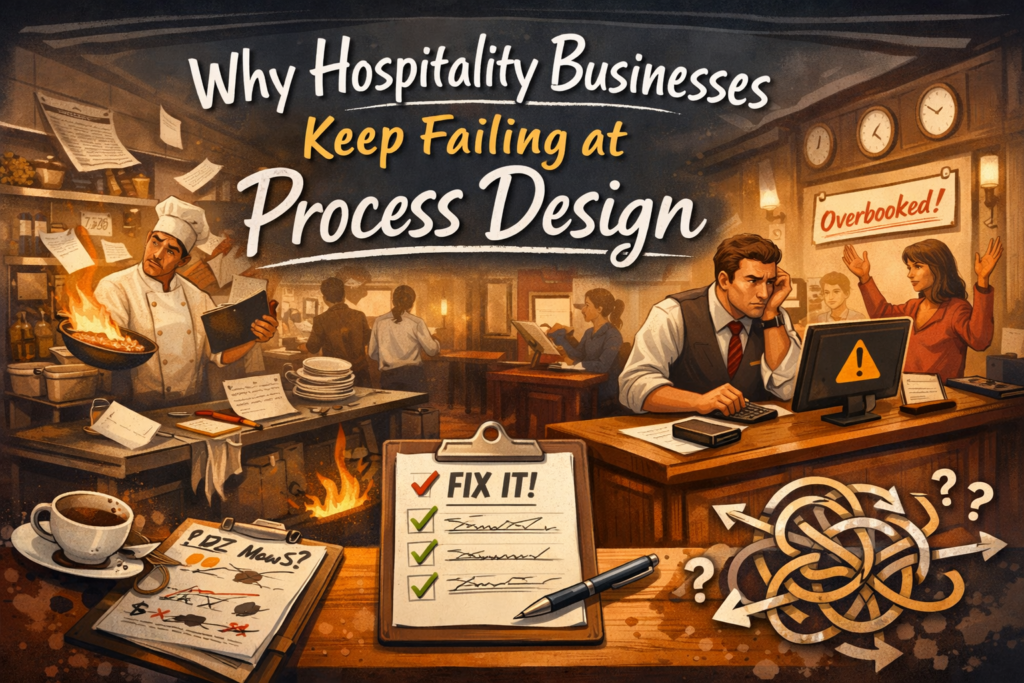
Hospitality is one of the hardest industries in the world to run well.
Not because people don’t care. Most people in hospitality care a lot.
It’s hard because everything is happening at once, in real time, with real customers watching. There’s no “we’ll fix it in the next release” like in tech. If something breaks, it breaks in front of someone who’s paying you.
And yet… process design is the thing so many hospitality businesses avoid until they’re forced into it.
Which is a shame, because most of the chaos in hospitality isn’t caused by bad staff.
It’s caused by messy systems.
Let’s talk about why.
It’s Not a Staff Problem. It’s a System Problem.
When something goes wrong in a restaurant or hotel, it usually gets blamed on a person.
- “They forgot to restock.”
- “He rang it in wrong.”
- “She didn’t follow the steps.”
But if the same problems keep showing up week after week, it’s rarely because everyone is suddenly incompetent.
It’s usually because the business is running on memory, luck, and a couple of overworked people holding everything together.
That’s not a process.
That’s survival mode.
1) Hospitality Confuses “Great Service” With “Everyone Doing Their Own Thing”
A lot of owners and managers don’t want things to feel robotic. Totally fair.
They want personality. They want staff to sound natural. They want guests to feel like they’re being taken care of by real humans, not a script.
So they avoid processes.
Or they keep them super loose.
But here’s the issue: when everyone does it “their way,” the customer experience becomes a lottery.
One server is amazing. The next one is brand new and overwhelmed. One bartender is fast and organised. The next one is making it up as they go.
Guests don’t experience your intentions. They experience your consistency.
And consistency doesn’t come from good vibes.
It comes from design.
2) Most Businesses Accidentally Build Their Operations Around One “Hero”
Every hospitality place has one.
That person who seems to know everything.
They can handle the rush.
They can calm down angry guests.
They can fix mistakes without making it obvious.
They can jump between roles like it’s nothing.
And honestly, they’re amazing.
But here’s the danger: a lot of businesses rely on that person so heavily that they don’t realise they’ve built the whole operation around them.
So the place runs smoothly when they’re on shift…
…and falls apart when they’re not.
That’s not a strong business.
That’s a fragile one.
A good process should work even when your best employee is on holiday.
3) They Make Checklists… But Skip the “Why”
This is a big one.
A lot of hospitality processes are basically:
“Do these steps.”
“Tick these boxes.”
“Follow this checklist.”
But when things get busy (which they always do), people stop following steps and start making decisions on the fly.
And that’s not because they’re lazy.
It’s because the checklist doesn’t help them in the moment.
What actually helps is when staff understand the point of what they’re doing.
For example:
Are we prioritising speed right now?
Or are we prioritising accuracy?
Or are we prioritising guest experience even if it takes longer?
If your team understands what matters most, they can make better calls under pressure.
That’s the difference between “process” and “rules.”
4) A Lot of Processes Look Great… Until Friday Night Hits
Some processes are designed in calm conditions.
In an office.
In a manager meeting.
On a slow Tuesday.
But hospitality doesn’t run in calm conditions.
It runs in:
- the dinner rush
- the surprise group booking
- the delivery that’s late
- the kitchen falling behind
- the POS system freezing
- two staff calling in sick
A process that only works when everything goes right is not a real process.
A real process is built for the messy version of your business.
Because that’s the version you live in most of the time.
5) They Overthink the Small Stuff and Ignore the Moments That Actually Matter
This happens constantly.
Businesses will spend ages trying to perfect things like:
- how menus are placed
- what the uniform rules are
- the “correct” way to greet a guest
- how to stack plates
Meanwhile, the big moments are basically a free-for-all:
- What do we do when a guest is furious?
- Who handles refunds and when?
- What’s the standard response to a food allergy?
- How do we recover service without giving away the whole bill?
- What happens when you’re overbooked?
Those moments are the ones that decide whether a guest comes back.
And too often they’re left to whoever is most confident in the moment.
6) Process Feels Like Micromanagement (So People Avoid It)
This is the part nobody says out loud.
A lot of staff hear “process” and think:
“More rules.”
“More management watching me.”
“More blame when something goes wrong.”
And honestly, they’re not wrong to feel that way, because plenty of businesses use process like a weapon.
But good process isn’t there to control people.
It’s there to support them.
It’s meant to reduce stress, reduce mistakes, and stop the constant “what are we doing again?” conversations mid-shift.
Good process should make the job easier, not heavier.
7) They Don’t Notice the Daily Friction Because They’re Used to It
Here’s the sneaky part: most hospitality businesses get used to their own chaos.
They accept things like:
- staff constantly asking where things are
- orders getting remade
- miscommunication between FOH and BOH
- “I thought you were doing that”
- managers stepping in to fix small issues all day
They see it as normal.
But it’s not normal. It’s expensive.
It costs time, energy, and staff morale.
And over time, it creates burnout.
So What Does “Good Process” Actually Look Like in Hospitality?
It’s not corporate.
It’s not complicated.
It doesn’t kill personality.
Good process is basically just this:
Make it easier for your team to do the right thing, especially when it’s busy.
That’s it.
A good process is:
- easy to follow
- realistic on a busy shift
- clear about who owns what
- built with the people doing the work (not just managers)
- updated regularly instead of sitting in a dusty binder
And most importantly…
It protects the guest experience and the staff experience.
The Real Truth
Most hospitality businesses don’t fail because they lack passion.
They fail because passion can’t hold a business together forever.
At some point, the business needs to run on something stronger than adrenaline and a few reliable people doing heroics every day.
If you don’t design your processes on purpose…
you’ll still have processes.
They’ll just be unofficial ones made up of:
bad habits,
tribal knowledge,
shortcuts,
and “this is how we’ve always done it.”
The Best Place to Start
If you want to fix process without making your business feel cold or robotic, start with one simple question:
What do we want every guest to feel, every time they walk in?
Then build your operations around making that feeling repeatable.
Because hospitality isn’t about being perfect.
It’s about being trusted.
And trust comes from consistency.